
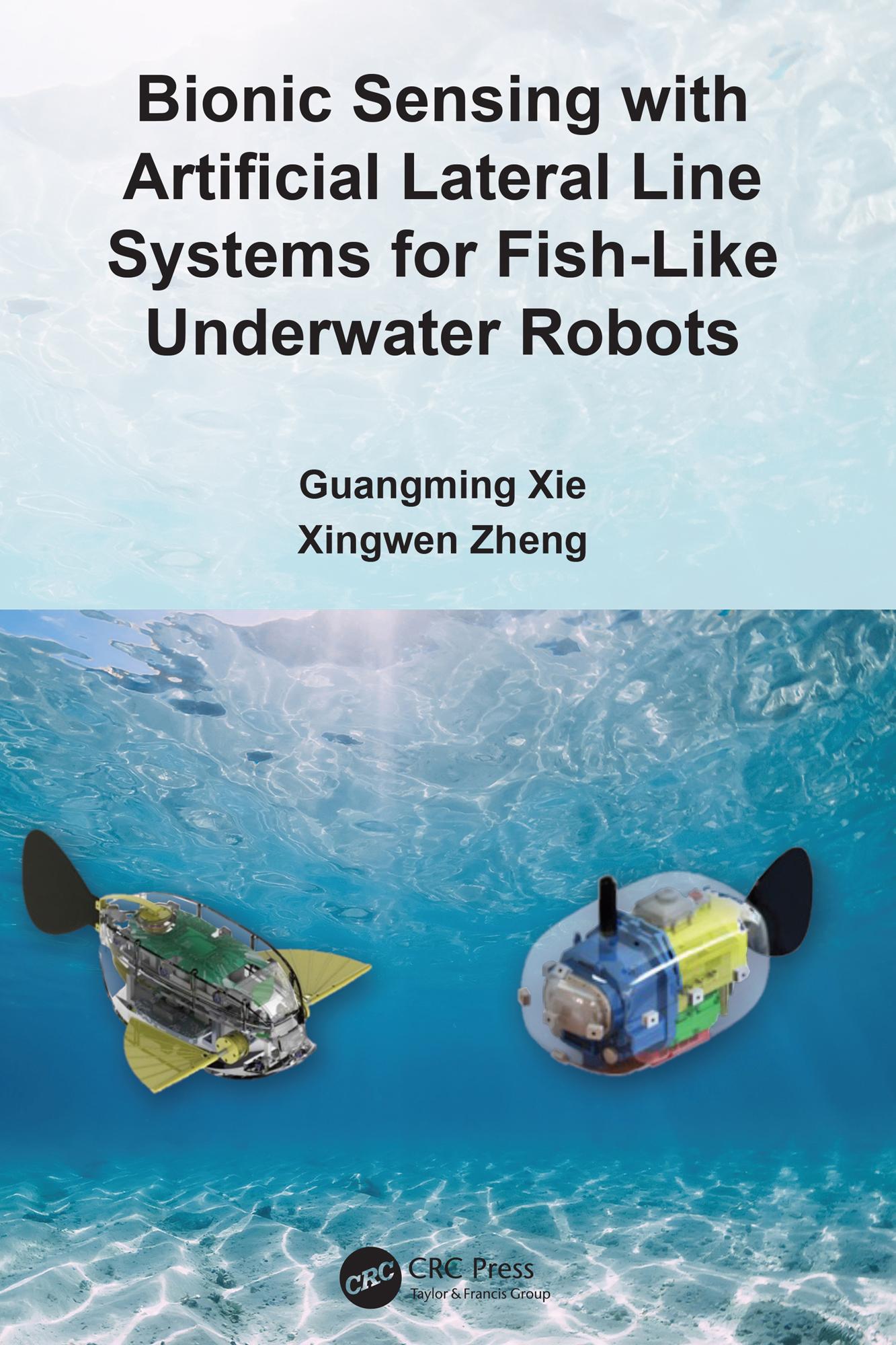
In this book, the authors first introduce two fish-like underwater robots, including a multiple fins-actuated robotic fish and a caudal fin-actuated robotic fish with a barycenter regulating mechanism. They study how a robotic fish uses its onboard pressure sensor arrays based-ALLS to estimate its trajectory in multiple locomotions, including rectilinear motion, turning motion, ascending motion, and spiral motion. In addition, they also explore the ALLS-based relative position and attitude perception between two robotic fish in a leader-follower formation. Four regression methods—multiple linear regression methods, support vector regressions, back propagation neural networks, and random forest methods—are used to evaluate the relative positions or attitudes using the ALLS data.
The research on ALLS-based local sensing between two adjacent fish robots extends current research from one individual underwater robot to two robots in formation, and will attract increasing attention from scholars of robotics, underwater technology, biomechanics and systems, and control engineering.
Pay easily by card, Klarna, Apple Pay or Google Pay. Not happy? You always have a 14-day money-back guarantee. Read more in our terms. If you have any questions, email us at hello@memmo.org.
Memmo makes studying easier – wherever you are in the world. We bring your course books and smart study tools together in one place: summaries, quizzes, podcasts and flashcards. Plus Ted, your study buddy who answers anything you wonder. Over 50,000 students already study here – built to help you learn faster and stress less.