
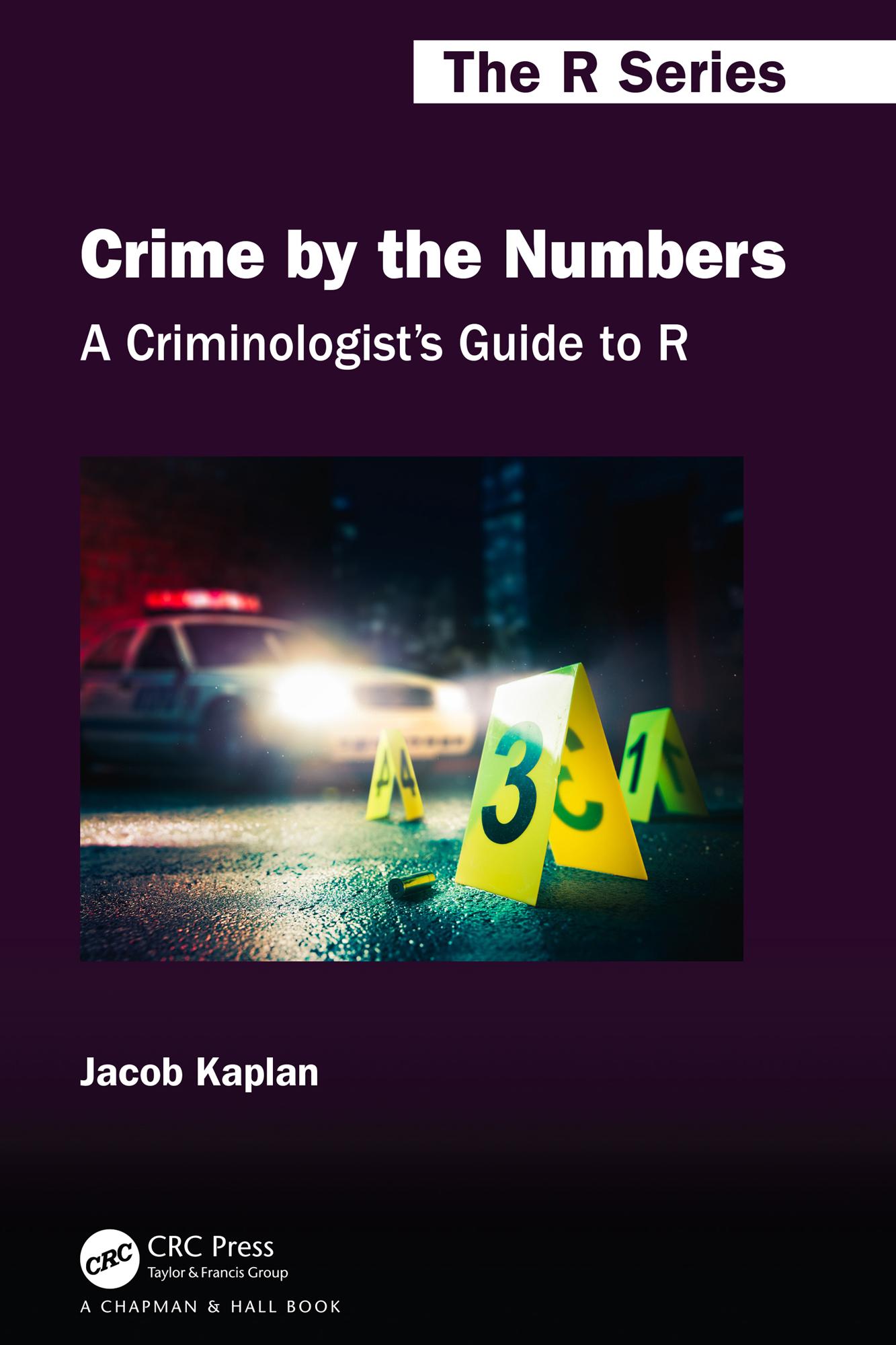
A Criminologist's Guide to R: Crime by the Numbers introduces the programming language R and covers the necessary skills to conduct quantitative research in criminology. By the end of this book, a person without any prior programming experience can take raw crime data, be able to clean it, visualize the data, present it using R Markdown, and change it to a format ready for analysis. A Criminologist's Guide to R focuses on skills specifically for criminology such as spatial joins, mapping, and scraping data from PDFs, however any social scientist looking for an introduction to R for data analysis will find this useful.
Key Features:
- Introduction to RStudio including how to change user preference settings.
- Basic data exploration and cleaning – subsetting, loading data, regular expressions, aggregating data.
- Graphing with ggplot2.
- How to make maps (hotspot maps, choropleth maps, interactive maps).
- Webscraping and PDF scraping.
- Project management – how to prepare for a project, how to decide which projects to do, best ways to collaborate with people, how to store your code (using git), and how to test your code.
Pay easily by card, Klarna, Apple Pay or Google Pay. Not happy? You always have a 14-day money-back guarantee. Read more in our terms. If you have any questions, email us at hello@memmo.org.
Memmo makes studying easier – wherever you are in the world. We bring your course books and smart study tools together in one place: summaries, quizzes, podcasts and flashcards. Plus Ted, your study buddy who answers anything you wonder. Over 50,000 students already study here – built to help you learn faster and stress less.