
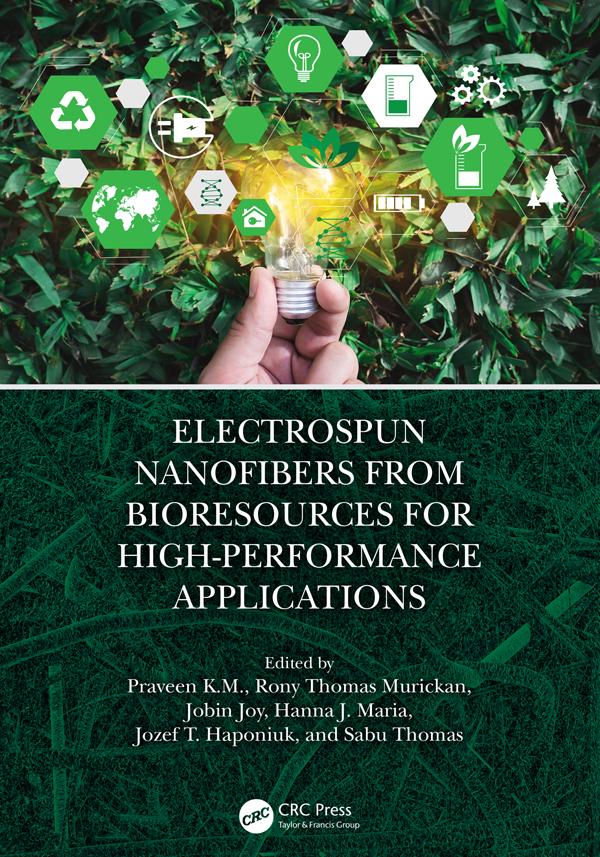
Nanofibers are possible solutions for a wide spectrum of research and commercial applications and utilizing inexpensive bio-renewable and agro waste materials to produce nanofibers can lower manufacturing cost via electrospinning. This book explains synthesis of green, biodegradable, and environmentally friendly nanofibers from bioresources, their mechanical and morphological characteristics along with their applications across varied areas. It gives an elaborate idea on conductive polymers for tissue engineering application as well.
Features:
- Provides insight about electrospun nanofibers from green, biodegradable and environmentally friendly bio resources.
- Reviews surface characterization of electrospun fibers.
- Covers diversified applications such as cancer treatment, COVID-19 solutions, food packaging applications, textile materials, and flexible electronic devices.
- Describes the combined use of 3D printing and electrospinning for tissue engineering scaffolds.
- Includes Melt electrospinning technique and its advantages over Solution electrospinning
This book aims at Researchers and Graduate Students in Material Science and Engineering, Environmental Engineering, Chemical Engineering, Electrical Engineering, Mechanical Engineering, and Biomedical Engineering.
Pay easily by card, Klarna, Apple Pay or Google Pay. Not happy? You always have a 14-day money-back guarantee. Read more in our terms. If you have any questions, email us at hello@memmo.org.
Memmo makes studying easier – wherever you are in the world. We bring your course books and smart study tools together in one place: summaries, quizzes, podcasts and flashcards. Plus Ted, your study buddy who answers anything you wonder. Over 50,000 students already study here – built to help you learn faster and stress less.