
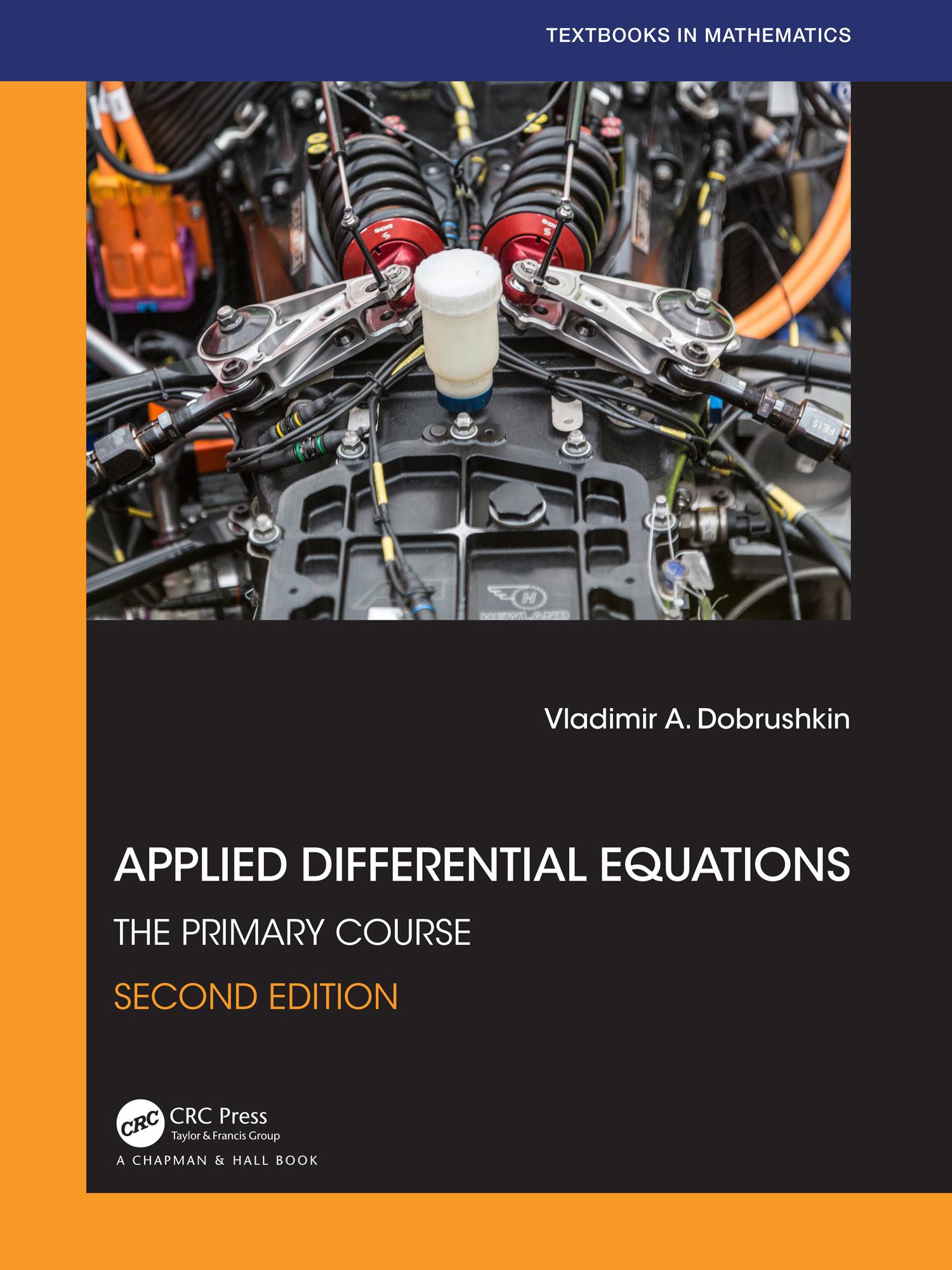
This book started as a collection of lecture notes for a course in differential equations taught by the Division of Applied Mathematics at Brown University. To some extent, it is a result of collective insights given by almost every instructor who taught such a course over the last 15 years. Therefore, the material and its presentation covered in this book were practically tested for many years.
This text is designed for a two-semester sophomore or junior level course in differential equations. It offers novel approaches in presentation and utilization of computer capabilities. This text intends to provide a solid background in differential equations for students majoring in a breadth of fields.
Differential equations are described in the context of applications. The author stresses differential equations constitute an essential part of modeling by showing their applications, including numerical algorithms and syntax of the four most popular software packages. Students learn how to formulate a mathematical model, how to solve differential equations (analytically or numerically), how to analyze them qualitatively, and how to interpret the results.
In writing this textbook, the author aims to assist instructors and students through:
- Showing a course in differential equations is essential for modeling real-life phenomena
- Stressing the mastery of traditional solution techniques and presenting effective methods, including reliable numerical approximations
- Providing qualitative analysis of ordinary differential equations. The reader should get an idea of how all solutions to the given problem behave, what are their validity intervals, whether there are oscillations, vertical or horizontal asymptotes, and what is their long-term behavior
- The reader will learn various methods of solving, analysis, visualization, and approximation, exploiting the capabilities of computers
- Introduces and employs Maple™, Mathematica®, MatLab®, and Maxima
- This textbook facilitates the development of the student’s skills to model real-world problems
Ordinary and partial differential equations is a classical subject that has been studied for about 300 years. The beauty and utility of differential equations and their application in mathematics, biology, chemistry, computer science, economics, engineering, geology, neuroscience, physics, the life sciences, and other fields reaffirm their inclusion in myriad curricula.
A great number of examples and exercises make this text well suited for self-study or for traditional use by a lecturer in class. Therefore, this textbook addresses the needs of two levels of audience, the beginning and the advanced.
Pay easily by card, Klarna, Apple Pay or Google Pay. Not happy? You always have a 14-day money-back guarantee. Read more in our terms. If you have any questions, email us at hello@memmo.org.
Memmo makes studying easier – wherever you are in the world. We bring your course books and smart study tools together in one place: summaries, quizzes, podcasts and flashcards. Plus Ted, your study buddy who answers anything you wonder. Over 75,000 students already study here – built to help you learn faster and stress less.