
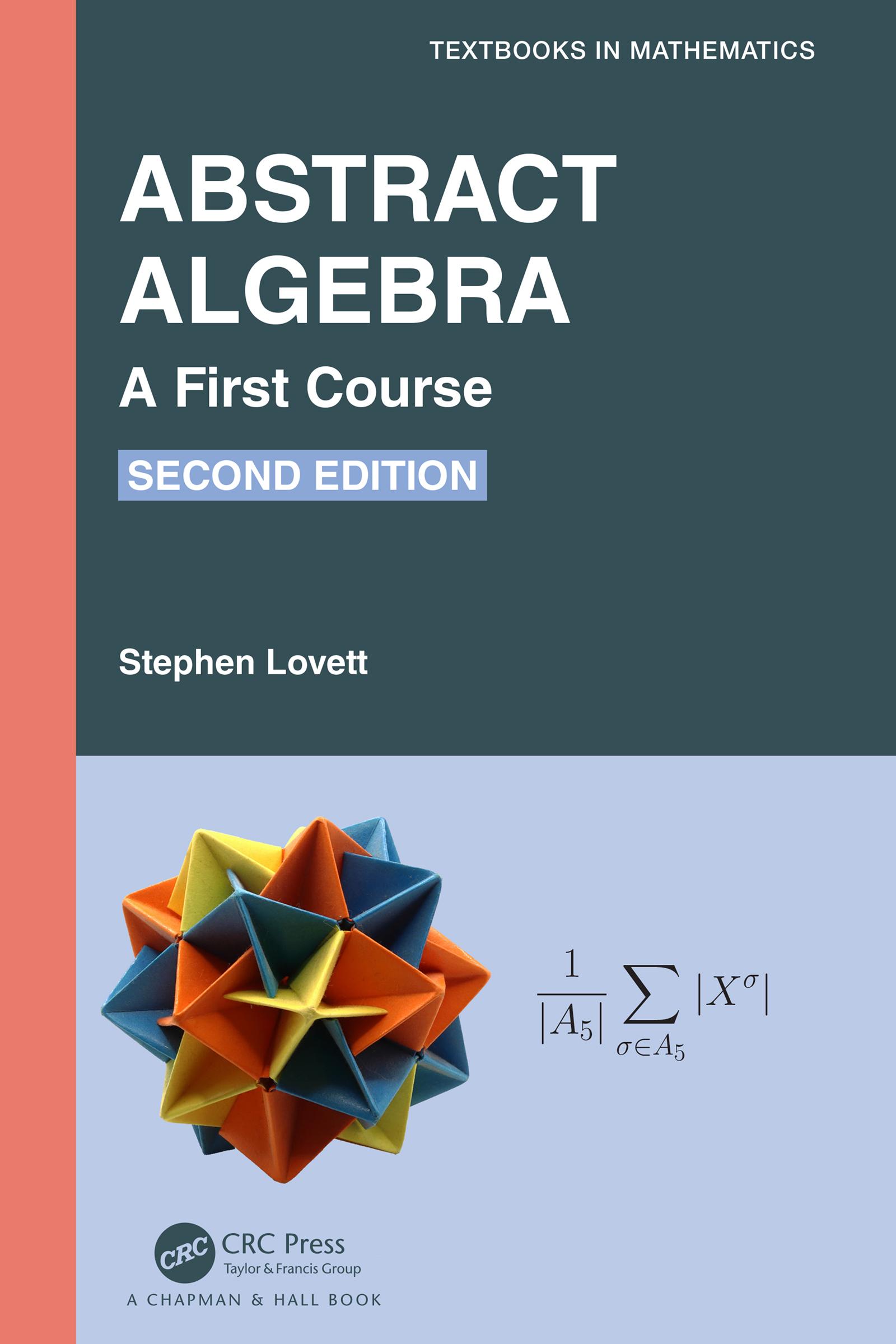
When a student of mathematics studies abstract algebra, he or she inevitably faces questions in the vein of, "What is abstract algebra" or "What makes it abstract?"
Algebra, in its broadest sense, describes a way of thinking about classes of sets equipped with binary operations. In high school algebra, a student explores properties of operations (+, −, ×, and ÷) on real numbers.
Abstract algebra studies properties of operations without specifying what types of number or object we work with. Any theorem established in the abstract context holds not only for real numbers but for every possible algebraic structure that has operations with the stated properties.
This textbook intends to serve as a first course in abstract algebra. The selection of topics serves both of the common trends in such a course: a balanced introduction to groups, rings, and fields; or a course that primarily emphasizes group theory.
The writing style is student-centered, conscientiously motivating definitions and offering many illustrative examples. Various sections or sometimes just examples or exercises introduce applications to geometry, number theory, cryptography and many other areas.
This book offers a unique feature in the lists of projects at the end of each section. the author does not view projects as just something extra or cute, but rather an opportunity for a student to work on and demonstrate their potential for open-ended investigation.
The projects ideas come in two flavors: investigative or expository. The investigative projects briefly present a topic and posed open-ended questions that invite the student to explore the topic, asking and to trying to answer their own questions.
Expository projects invite the student to explore a topic with algebraic content or pertain to a particular mathematician’s work through responsible research.
The exercises challenge the student to prove new results using the theorems presented in the text. The student then becomes an active participant in the development of the field.
Pay easily by card, Klarna, Apple Pay or Google Pay. Not happy? You always have a 14-day money-back guarantee. Read more in our terms. If you have any questions, email us at hello@memmo.org.
Memmo makes studying easier – wherever you are in the world. We bring your course books and smart study tools together in one place: summaries, quizzes, podcasts and flashcards. Plus Ted, your study buddy who answers anything you wonder. Over 75,000 students already study here – built to help you learn faster and stress less.