
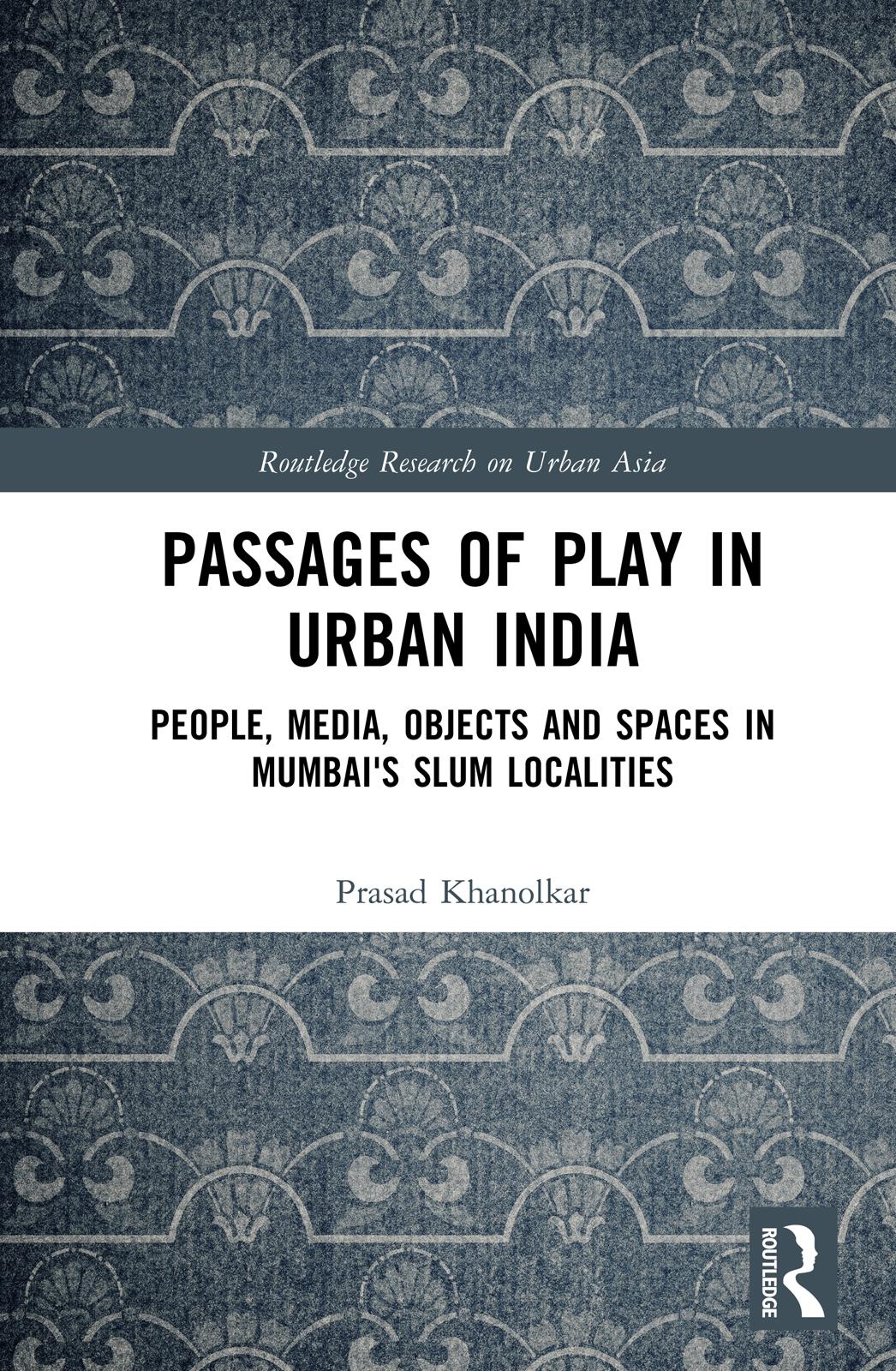
In this book, Prasad Khanolkar offers a new way of thinking about ‘slums’ and southern cities based on a grounded engagement with the relationship between media, objects, spaces, and people in the everyday life of slum localities in Mumbai, India.
Over the past few decades, Mumbai, like many cities in the global South, has experienced a series of overarching governmental missions to program it into an interoperable and profitable city. Its ‘slums’, which house a majority of its population don’t fit within the dominant registers and continue to be deemed as excess. Urban residents inhabiting Mumbai’s slum localities thus find themselves in the middle of missions, policies, and programs that are not of their making, just as often that they find themselves localized by lack of resources, caste system, communal conflicts, and territorial jurisdictions. Drawing on extensive fieldwork in slum localities of Mumbai, this book explores how its residents engage in different forms of play in order to extend and expand their field of possibilities, despite the limitations and fixities. The book attends to some of these playacts: imparting stories with different thicknesses, rehearsing roles on and offscreen, engaging in deceptive performances, experimenting with repetitive everyday rhythms, and recycling matter and forms. Through these playacts, urban residents explore the virtual abilities of different mediums to put bodies, objects, and spaces into new forms of relationships and create passages to depart from programmed urban futures. By attending to these proliferating urban passages of different residents in slum localities, the book makes a case for rethinking southern cities as mediums for urban lives to converge and depart without an overarching framework.
The book makes a significant contribution in the field of urban studies, urban anthropology, urban geography, and urban sociology. It will be of interest to scholars and students working on postcolonial cities, Southern urbanisms, infrastructure studies, and urban planning in the global South.
Pay easily by card, Klarna, Apple Pay or Google Pay. Not happy? You always have a 14-day money-back guarantee. Read more in our terms. If you have any questions, email us at hello@memmo.org.
Memmo makes studying easier – wherever you are in the world. We bring your course books and smart study tools together in one place: summaries, quizzes, podcasts and flashcards. Plus Ted, your study buddy who answers anything you wonder. Over 75,000 students already study here – built to help you learn faster and stress less.