
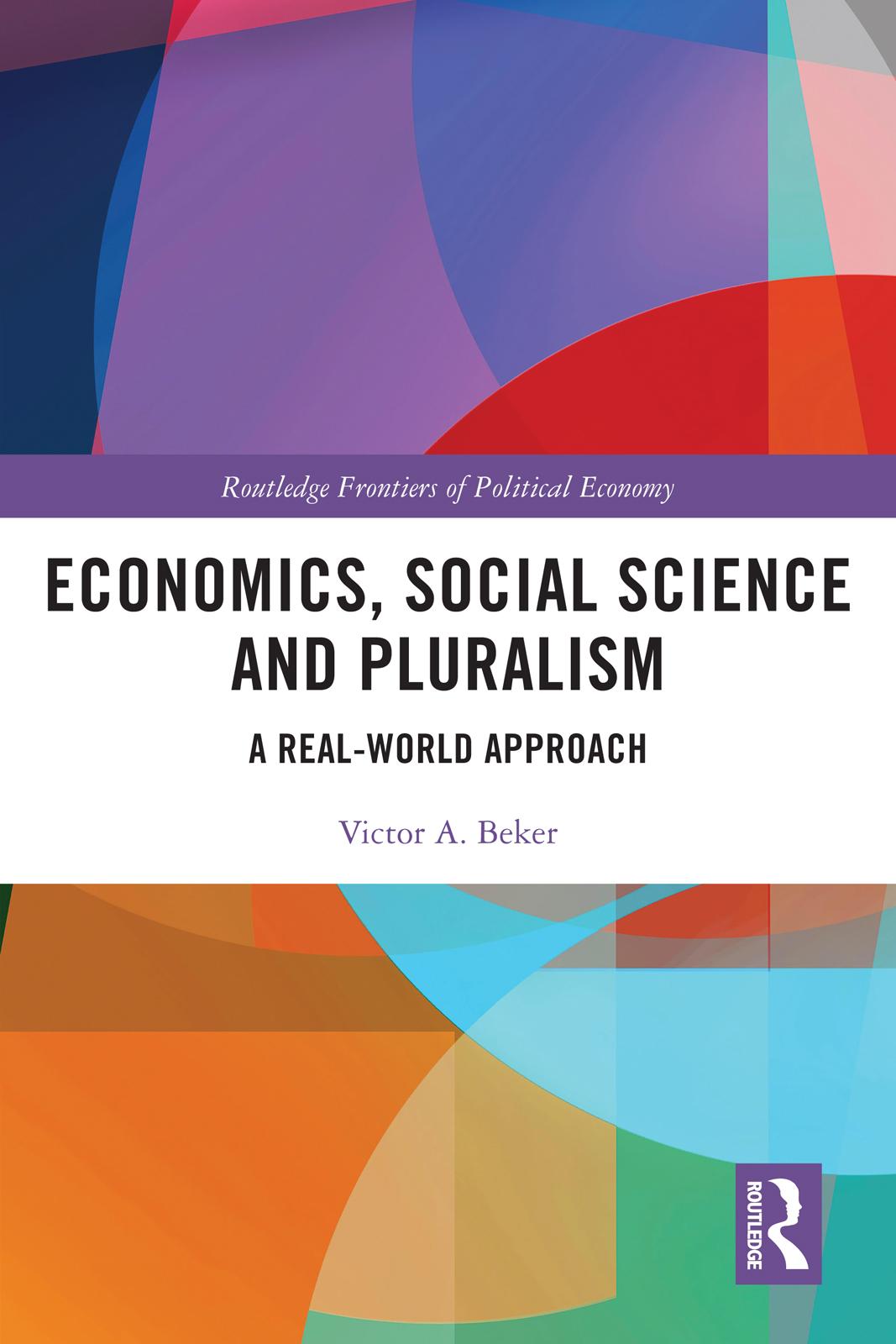
In the work of most classical economists – including Smith and Keynes – theory was often embedded in application. But from the second half of the last century on, mainstream economics styled itself as "pure" economics, where the theory is presented in a very abstract form detached from any application. This book maintains that economics is a social science whose mission is to explain and, when possible, predict, phenomena of the real-world economy. The book argues that the first step to restoring economics as a social science is to define what issues economics should address. Only after this research agenda is established should the appropriate methodology be chosen, not the other way around. In this respect, examples from other social sciences as well as from natural sciences are considered more appropriate models for economics rather than physics. Moreover, the need for a closer interaction with psychology, sociology and other social sciences is required to restore the discipline to that field instead of acting as a branch of applied mathematics. The book also argues for a more pluralist approach to economic education to enable prospective economists to understand real-world economic phenomena and potential policy solution. For this reason, a good economics education should necessarily include the study of economic history and of the institutional environment.
This book is essential reading for anyone who wants to see economics return to its origins as a social science.
Pay easily by card, Klarna, Apple Pay or Google Pay. Not happy? You always have a 14-day money-back guarantee. Read more in our terms. If you have any questions, email us at hello@memmo.org.
Memmo makes studying easier – wherever you are in the world. We bring your course books and smart study tools together in one place: summaries, quizzes, podcasts and flashcards. Plus Ted, your study buddy who answers anything you wonder. Over 50,000 students already study here – built to help you learn faster and stress less.