
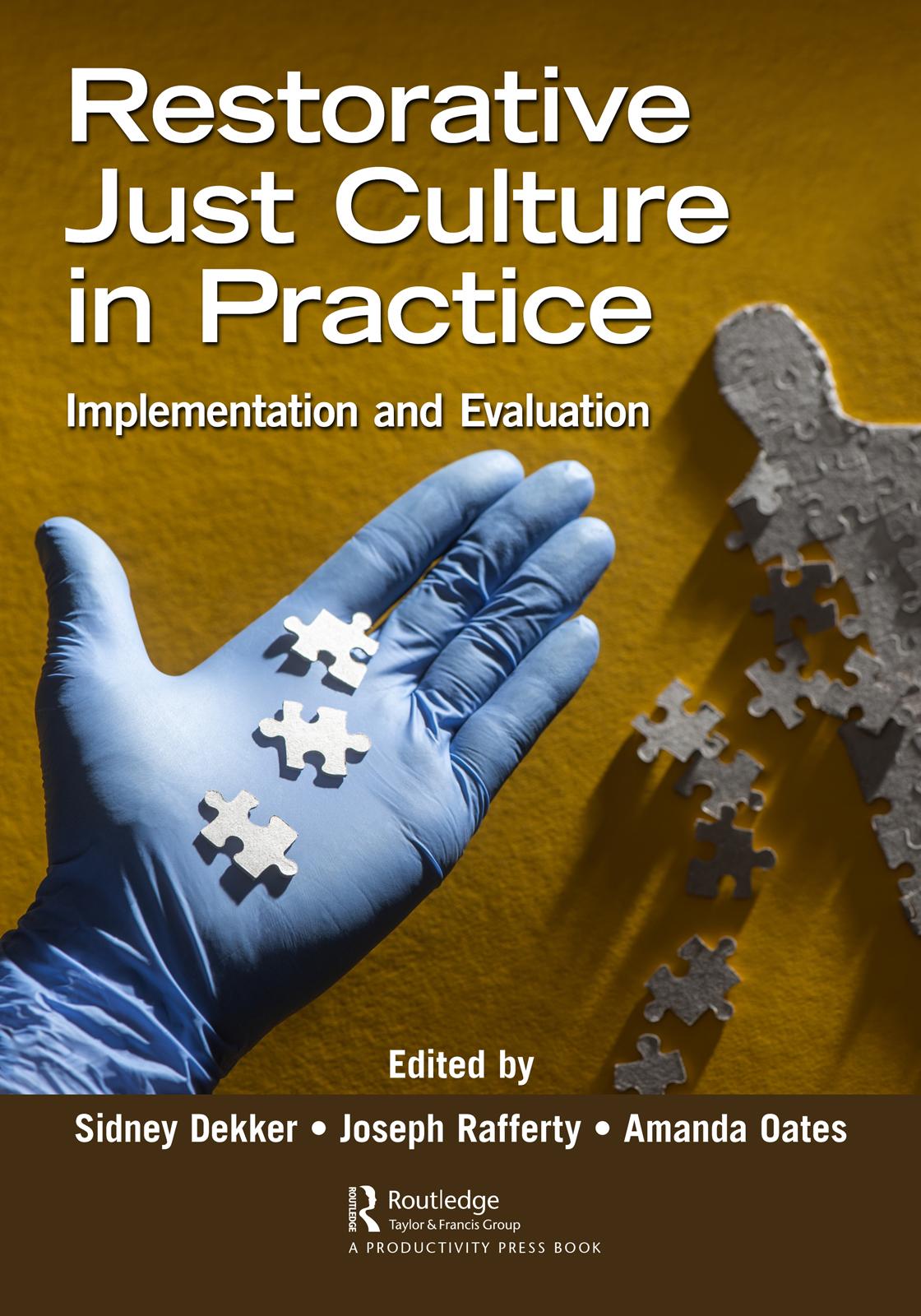
A restorative just culture has become a core aspiration for many organizations in healthcare and elsewhere. Whereas ‘just culture’ is the topic of some residual conceptual debate (e.g. retributive policies organized around rules,violations and consequences are ‘sold’ as just culture), the evidence base on, and business case for, restorative practice has been growing and is generating increasing, global interest. In the wake of an incident, restorative practices ask who are impacted, what their needs are and whose obligation it is to meet those needs. Restorative practices aim to involve participants from the entire community in the resolution and repair of harms.
This book offers organization leaders and stakeholders a practical guide to the experiences of implementing
and evaluating restorative practices and creating a sustainable just, restorative culture. It contains the perspectives from leaders, theoreticians regulators, employees and patient representatives. To the best of our knowledge, there is no book on the market today that can function as a guide for the implementation and evaluation of a just and learning culture and restorative practices. This book is intended to fill this gap. This book will provide, among other topics, an overview of restorative just culture principles and practices; a balanced treatment of the various implementations and evaluations of just culture and restorative processes; a guide for leaders about what to stop, start, increase and decrease in their own organizations; and an attentive to philosophical and historical traditions and assumptions that underlie just culture and restorative approaches.
The interest in ‘just culture’, not just in healthcare but also in other fields of safety-critical practice, has been steadily growing over the past decade. It is a trending area. In this, it has become clear that 20-year-old retributive models not only hinder the acceleration of performance and organizational improvement but have also in some cases become a blunt HR instrument, an expression of power over justice and a way to stifle honesty, reporting and learning. What is new in this, then, is the restorative angle on just culture, as it has been developed over the last few years and now is practised and applied to HR, suicide prevention, healthcareimprovement, regulatory innovations and other areas.
Pay easily by card, Klarna, Apple Pay or Google Pay. Not happy? You always have a 14-day money-back guarantee. Read more in our terms. If you have any questions, email us at hello@memmo.org.
Memmo makes studying easier – wherever you are in the world. We bring your course books and smart study tools together in one place: summaries, quizzes, podcasts and flashcards. Plus Ted, your study buddy who answers anything you wonder. Over 75,000 students already study here – built to help you learn faster and stress less.