
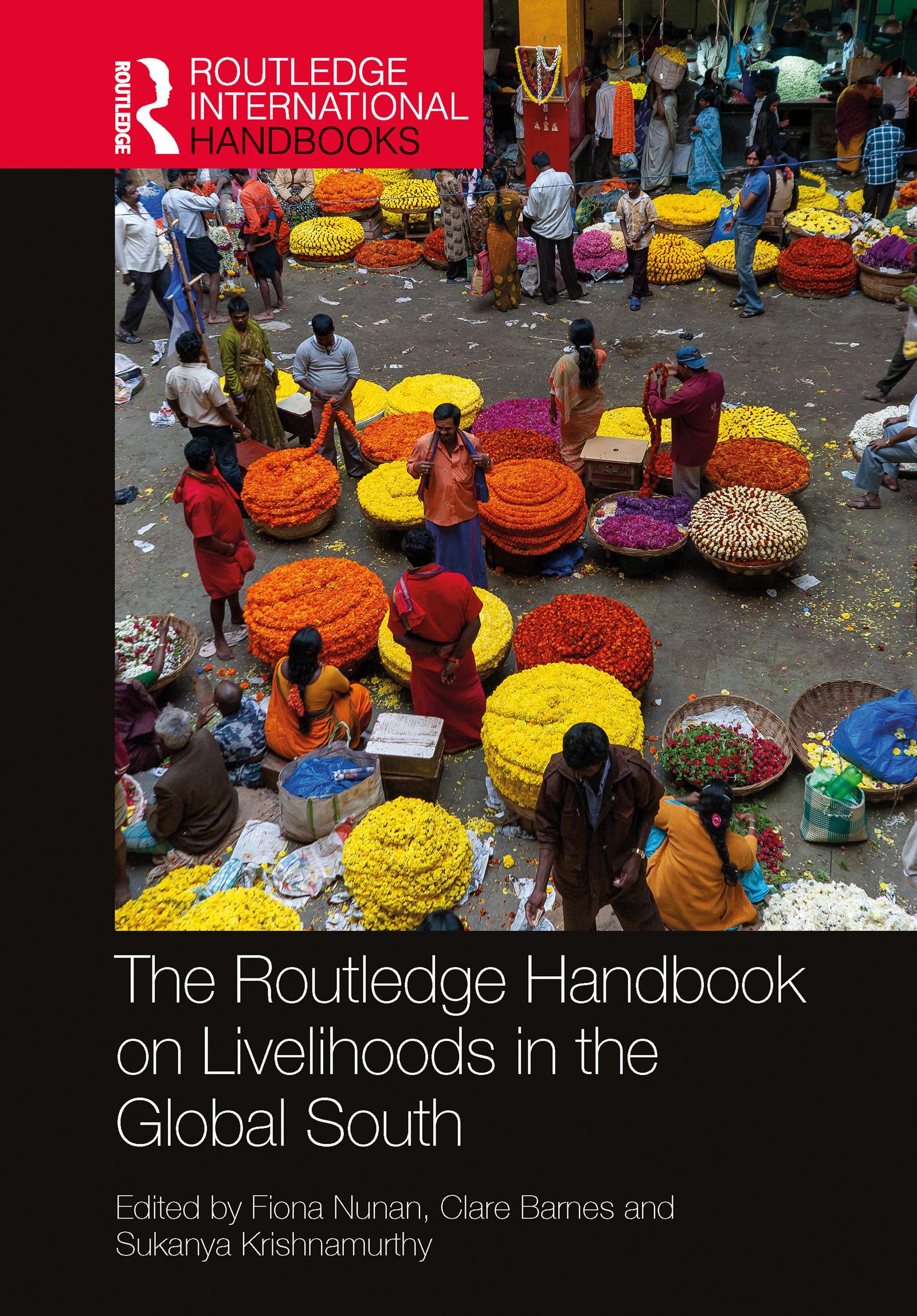
The Routledge Handbook on Livelihoods in the Global South presents a unique, timely, comprehensive overview of livelihoods in low- and middle-income countries. Since their widespread adoption in the 1990s, livelihoods perspectives, frameworks and methods have influenced diverse areas of research, policy and practice.
The concept of livelihoods reflects the complexity of strategies and practices used by individuals, households and communities to meet their needs and live their lives. The Handbook brings together insights and critical analysis from diverse approaches and experiences, learning from research and practice over the last 30 years. The Handbook comprises an introductory section on key concepts and frameworks, followed by five parts, on researching livelihoods, negotiating livelihoods, generating livelihoods, enabling livelihoods and contextualising livelihoods. The introduction provides readers with an appreciation of concepts researched and applied in the five parts, including chapters on vulnerability and resilience, social capital and networks, and institutions. Each part reflects the diversity of approaches taken to understanding livelihoods, whilst recognising commonalities, including the centrality of power in shaping, enabling and constraining livelihoods. The book also reflects diversity of context, including conflict, climate change and religion, as well as in generating livelihoods, through agriculture, small-scale mining and pastoralism. The aim of each chapter is to provide a critically informed introduction and overview of key concepts, issues and debates of relevance to the topic, with each chapter concluding with suggestions for further reading.
It will be an essential resource to students, researchers and practitioners of international development and related fields. Researchers and practitioners will also benefit from the book's diverse disciplinary contributions and by the wide and contemporary coverage.
Pay easily by card, Klarna, Apple Pay or Google Pay. Not happy? You always have a 14-day money-back guarantee. Read more in our terms. If you have any questions, email us at hello@memmo.org.
Memmo makes studying easier – wherever you are in the world. We bring your course books and smart study tools together in one place: summaries, quizzes, podcasts and flashcards. Plus Ted, your study buddy who answers anything you wonder. Over 50,000 students already study here – built to help you learn faster and stress less.