
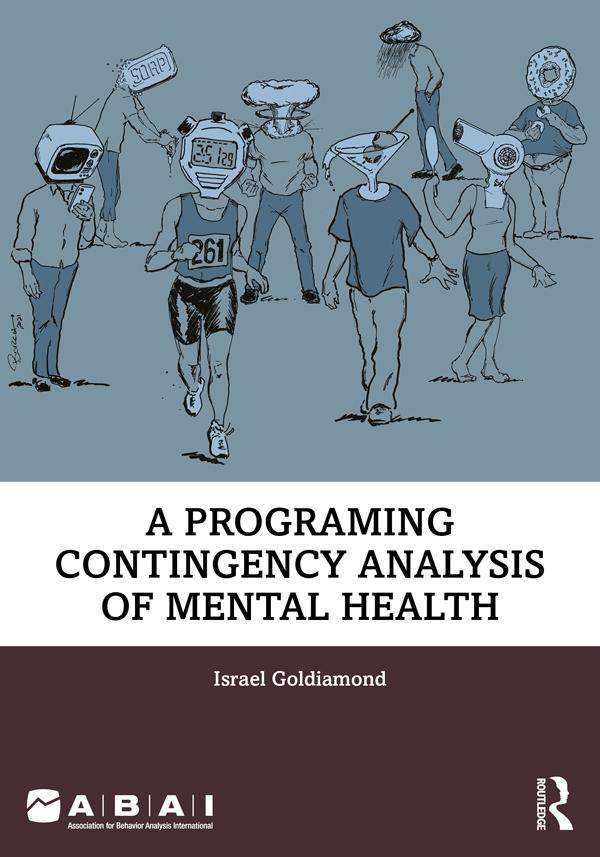
A Programing Contingency Analysis of Mental Health presents Dr. Israel Goldiamond’s reflections on various ways we formulate behavioral and emotional problems, most often in traditional terms of mental health disorders, mental diseases or illnesses, psychopathological disorders, and so on – what he calls a pathological orientation. Here, Goldiamond argues for a groundbreaking alternative view from the vantage point of radical behaviorism.
The book begins by discussing contingency relations between behavior and its past and present consequences, along with other environmental events. It reminds us that this approach sits comfortably alongside other consequential systems in the social and biological sciences, particularly decision theory and evolution. This behaviorist system regards most important human behaviors as being emitted rather than stimulus-elicited. Described are some of the diverse origins of behavior, including the effects of environmental consequences and the programing procedures of social and cultural inheritance. The exposition includes decision matrices which rationalize some of the programed patterns and the accompanying thoughts and emotions commonly found in mental illness. As a result of this nonlinear contingency analysis, such patterns may be considered adaptive rather than maladaptive. The book describes programs based on those matrices and outlines how they might be applied to mitigate any problems or costs associated with those patterns. The book concludes by moving from individual analysis to social analysis, with particular reference to some societal contingencies that may maintain the pathological orientation and others that might shift our gaze in the direction proposed here.
Alongside Dr. Goldiamond’s original work, this volume features a new introduction from Dr. Paul Thomas Andronis and Dr. T. V. Joe Layng, as well as an article tracing the history of the non-linear thinking of Dr. Goldiamond, first published in The Behavior Analyst. It will be a must-read for anyone working in the analysis of and clinical intervention in problems associated with mental health, or those more generally interested in the work of Israel Goldiamond.
Pay easily by card, Klarna, Apple Pay or Google Pay. Not happy? You always have a 14-day money-back guarantee. Read more in our terms. If you have any questions, email us at hello@memmo.org.
Memmo makes studying easier – wherever you are in the world. We bring your course books and smart study tools together in one place: summaries, quizzes, podcasts and flashcards. Plus Ted, your study buddy who answers anything you wonder. Over 50,000 students already study here – built to help you learn faster and stress less.