
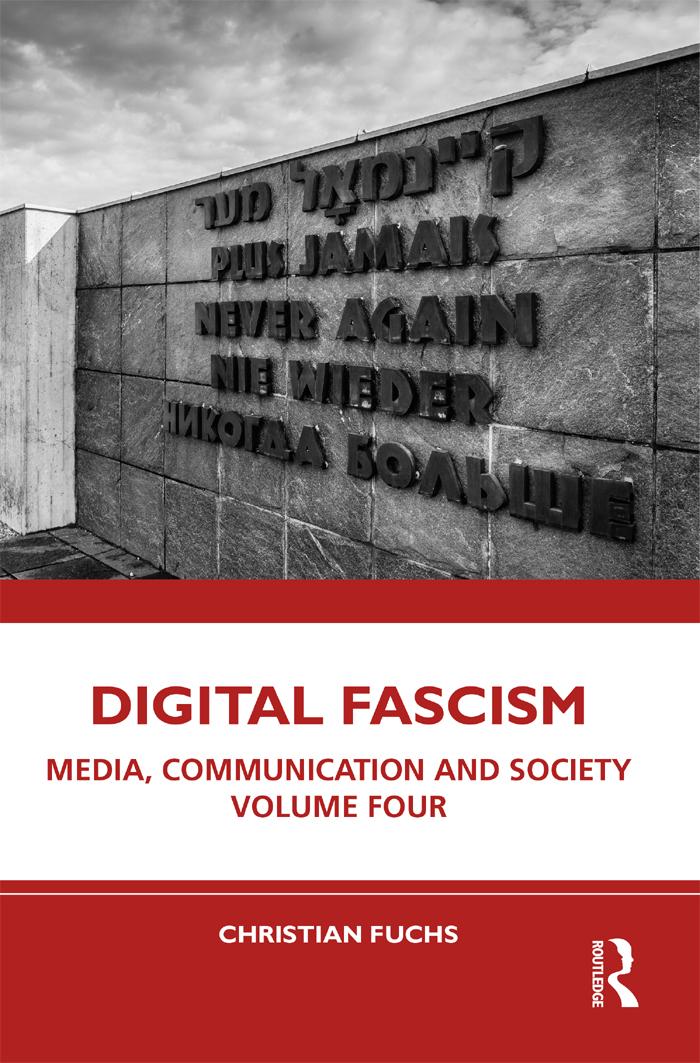
This fourth volume in Christian Fuchs’s Media, Communication and Society book series outlines the theoretical foundations of digital fascism and presents case studies of how fascism is communicated online.
Digital Fascism presents and engages with theoretical approaches and empirical studies that allow us to understand how fascism, right-wing authoritarianism, xenophobia, and nationalism are communicated on the Internet. The book builds on theoretical foundations from key theorists such as Theodor W. Adorno, Franz L. Neumann, Erich Fromm, Herbert Marcuse, Wilhelm Reich, Leo Löwenthal, Moishe Postone, Günther Anders, M. N. Roy, and Henry Giroux. The book draws on a range of case studies, including Nazi-celebrations of Hitler’s birthday on Twitter, the ‘red scare 2.0’ directed against Jeremy Corbyn, and political communication online (Donald Trump, Boris Johnson, the Austrian presidential election). These case studies analyse right-wing communication online and on social media. Fuchs argues for the safeguarding of the democratic public sphere and that slowing down and decommodifying the logic of the media can advance and renew debate culture in the age of digital authoritarianism, fake news, echo chambers, and filter bubbles.
Each chapter focuses on a particular dimension of digital fascism or a critical theorist whose work helps us to illuminate how fascism and digital fascism work, making this book an essential reading for both undergraduate and postgraduate students of media and communication studies, sociology, politics, and political economy as well as anyone who wants to understand what digital fascism is and how it works.
Pay easily by card, Klarna, Apple Pay or Google Pay. Not happy? You always have a 14-day money-back guarantee. Read more in our terms. If you have any questions, email us at hello@memmo.org.
Memmo makes studying easier – wherever you are in the world. We bring your course books and smart study tools together in one place: summaries, quizzes, podcasts and flashcards. Plus Ted, your study buddy who answers anything you wonder. Over 50,000 students already study here – built to help you learn faster and stress less.