
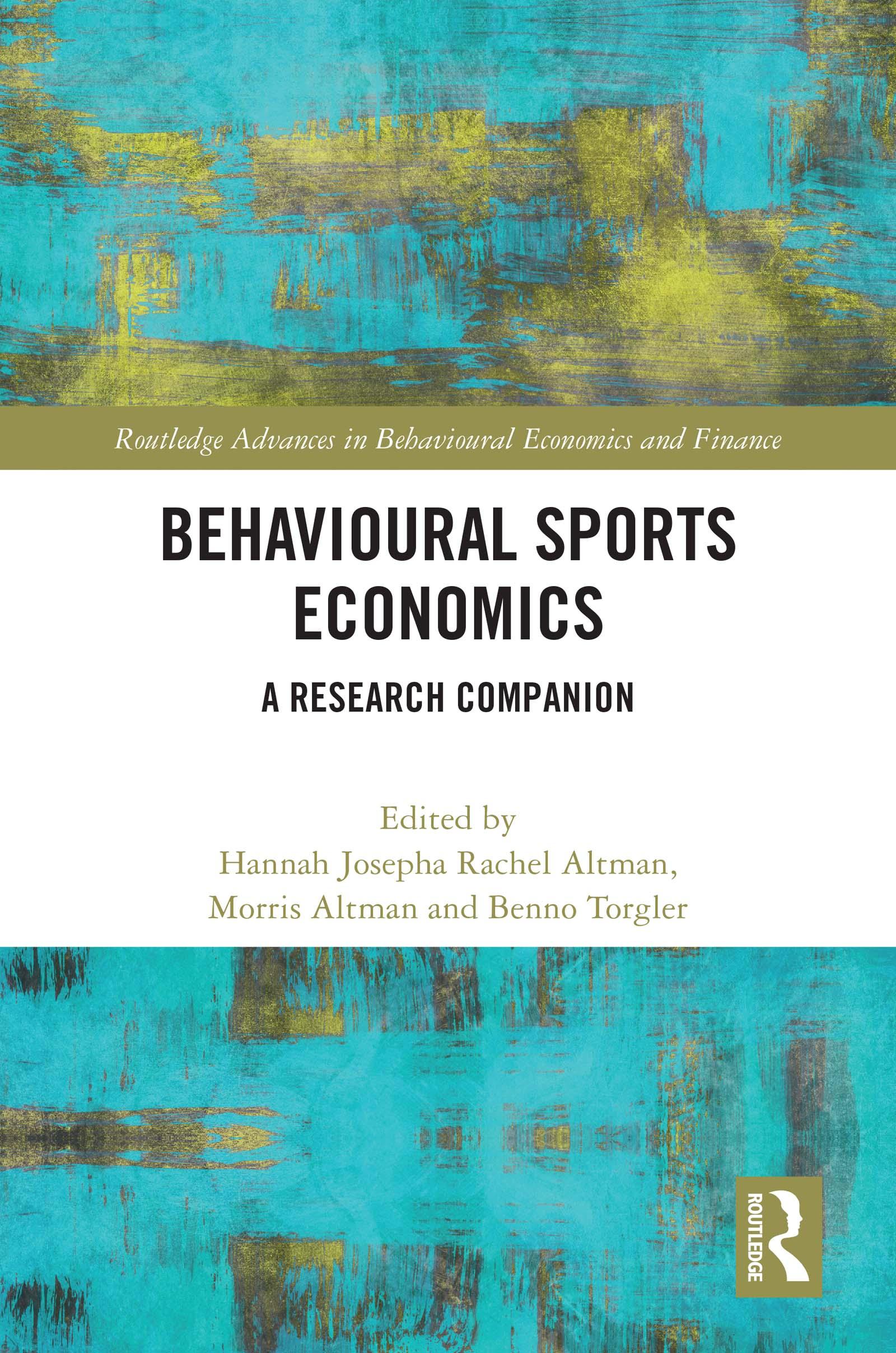
Economists have entered into the realm of sports to provide what they believe to be more cogent explanations for sport-related behaviour and to suggest ways in which incentives can improve sports outcomes. But prices and income, the traditional workhorses of conventional economics, can only provide partial explanations and understandings. Drawing on a bounded rationality approach to behavioural economics, this book demonstrates the analytical insights to be gained by supplementing the conventional economics toolbox with psychological, cognitive, sociological, and institutional factors.
The international cast list of contributors cover a wide range of sports topics on which a behavioural approach can reveal new insights. These include preferences, managerial, efficiency, choking, doping, favouritism, athlete well- being, and spectator behaviour. Throughout the book, there is an emphasis on the cognitive limits to smart decision-making as well as the critical role played by the decision-making environment. This volume demonstrates that adopting a bounded rationality approach, complimented with other behaviouralist approaches, helps to better explain sport-related behavioural, sub-optimal behavioural, and market failures. It also provides insights that could be used to improve sports outcomes and the well-being of those involved in sports and to better configure policy to enhance sports performance.
This groundbreaking book will be an indispensable reference to students and scholars of sports economics, sports management, and sports science.
Pay easily by card, Klarna, Apple Pay or Google Pay. Not happy? You always have a 14-day money-back guarantee. Read more in our terms. If you have any questions, email us at hello@memmo.org.
Memmo makes studying easier – wherever you are in the world. We bring your course books and smart study tools together in one place: summaries, quizzes, podcasts and flashcards. Plus Ted, your study buddy who answers anything you wonder. Over 50,000 students already study here – built to help you learn faster and stress less.