
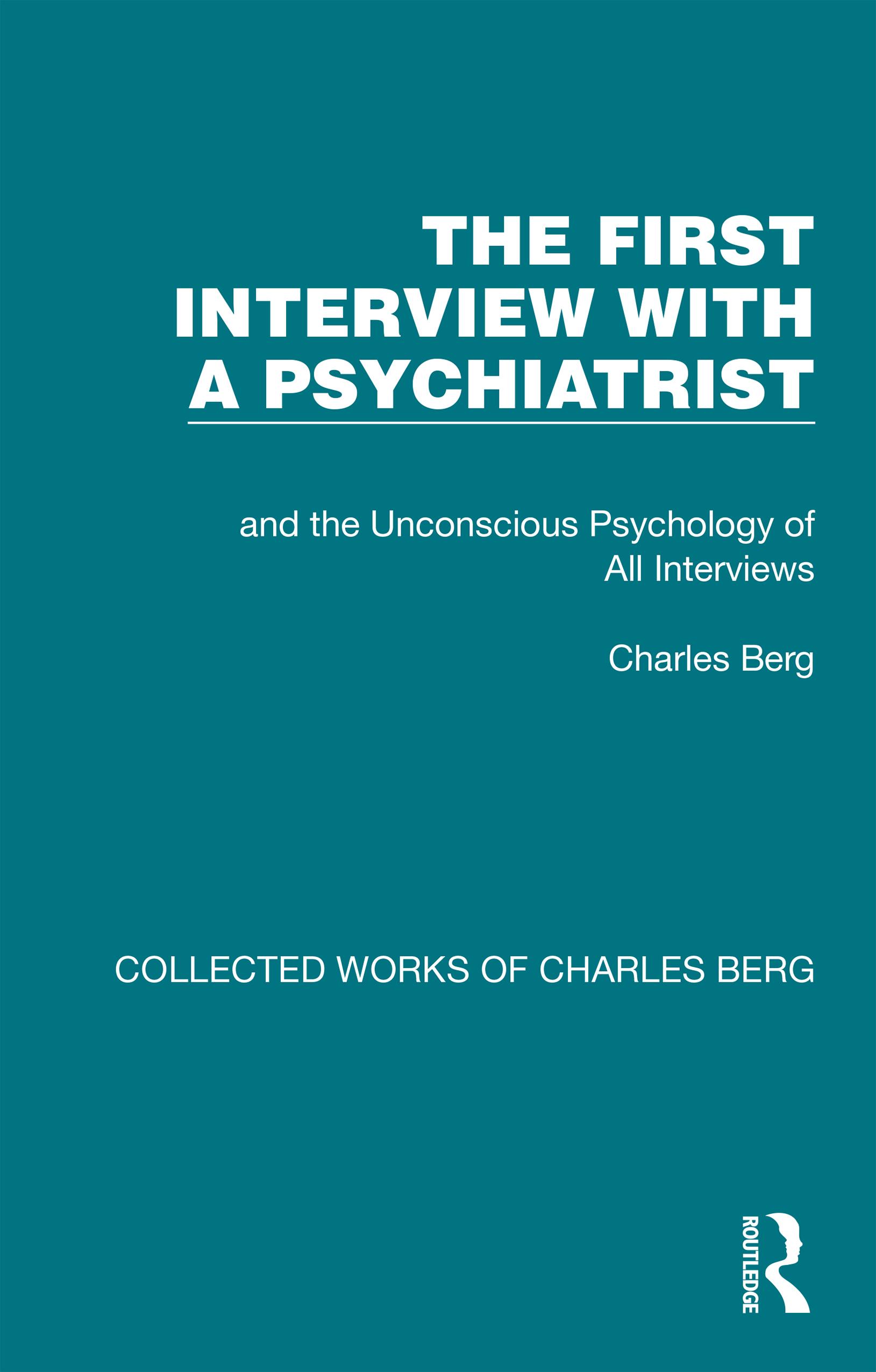
Originally published in 1955, the blurb read: 'Again in this book the author expounds his main thesis – perhaps the main thesis of all modern psychiatry – namely that our conscious pre-occupations, thoughts and behaviour are merely the products or "symptoms" of a process that is going on within us (basically a physiological process) of which we are totally unconscious. Although we are at pains to conceal from ourselves and others, and even vehemently to deny, the nature and the very existence of this fundamental unconscious process, it is nevertheless the determinant of all that is us, biologically, psychologically and sociologically. In the author’s own words: "It is the force behind all activity, all life. It exists unseen in the most apparently superficial human relationship, even in the interview – as this book will show. It alone can give us the meaning of what we do and feel."
The theoretical section of the book deals with the interviewer and the unconscious forces which determine the effects and the therapeutic results of the interview. The longer practical section demonstrates, by abundant examples from clinical material and by complete documentaries of actual psychiatric interviews, that it is unconscious forces which determine the patient’s symptomatic picture, his behaviour, his attitude to life, and above all his emotional relationship to the psychiatrist – and indeed to everyone he meets in every personal contact.
The elucidation of this process should be of the utmost interest and of the utmost practical value to each of us in our every contact, superficial or deep, with every human being whom we meet in the course of our lives.
The book will appeal to a wide public. Although it demonstrates the deepest and most worthwhile aspect of modern psychology and psychiatry, it avoids technical jargon and is written in a cheerful, lively and lucid style, easily assimilable by everybody.'
Today it can be read and enjoyed in its historical context.
This book is a re-issue originally published in 1955. The language used is a reflection of its era and no offence is meant by the Publishers to any reader by this re-publication.
Pay easily by card, Klarna, Apple Pay or Google Pay. Not happy? You always have a 14-day money-back guarantee. Read more in our terms. If you have any questions, email us at hello@memmo.org.
Memmo makes studying easier – wherever you are in the world. We bring your course books and smart study tools together in one place: summaries, quizzes, podcasts and flashcards. Plus Ted, your study buddy who answers anything you wonder. Over 50,000 students already study here – built to help you learn faster and stress less.