
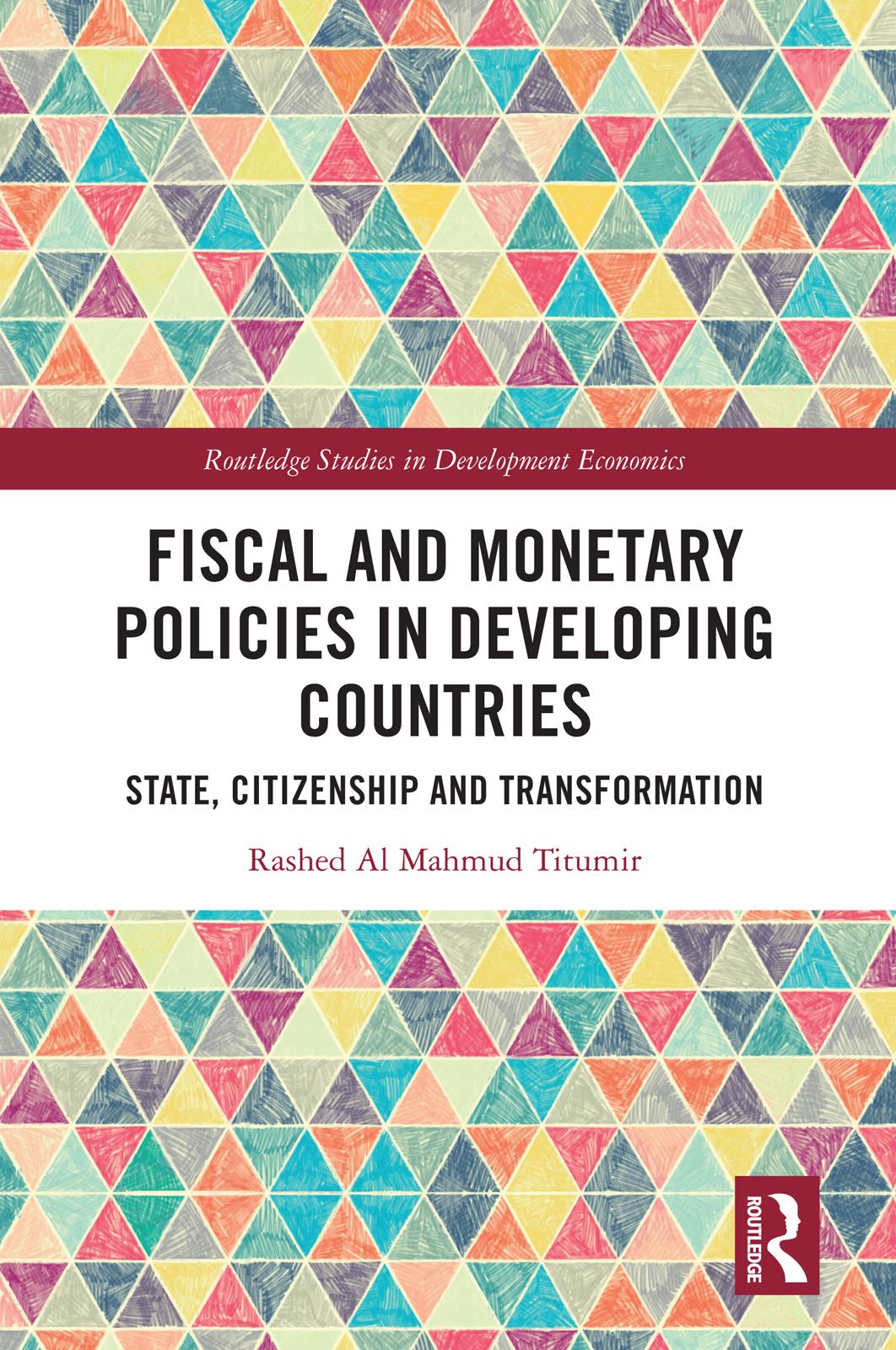
The COVID-19 crisis has fractured the pre-existing structural rigidities and institutional fragilities in the economies of developing countries more than ever, necessitating a rethinking of fiscal and monetary policies, the main vehicles for relief, recovery and reconstruction.
This book examines the barriers to transformation in developing countries in the wake of the pandemic and analyses the paths to recovery based on an economic policymaking agenda. It juxtaposes fiscal and monetary policies and state-building from pre- and post-colonial periods to the present-day context. It employs an interdisciplinary approach and ventures beyond the well-rehearsed tendency to explain the state of developing countries by considering the experiences of advanced economies. The book utilises data on three levels: the aggregate level using world data, the single-country context with case studies and a cross-country assessment for comparative analysis. Further, the book critically assesses the relevance of different schools of thought and provides nuanced, thought-provoking theoretical apparatuses applicable to developing countries, as well as allowing the reader to undertake a country-specific analysis through the detailed historical country case studies undertaken in each chapter. Each chapter has a detailed and separate theoretical and empirical section for the ease of understanding of the key propositions in the book.
The book will find an audience among scholars and researchers alike, who wish to gain a deeper understanding of the formulation of fiscal and monetary policies, specifically in developing countries. For policymakers and policy advocates, the book will serve as the groundwork for monetary and fiscal policies in the context of developing countries, providing more relevant instruments for transformational pathways.
Pay easily by card, Klarna, Apple Pay or Google Pay. Not happy? You always have a 14-day money-back guarantee. Read more in our terms. If you have any questions, email us at hello@memmo.org.
Memmo makes studying easier – wherever you are in the world. We bring your course books and smart study tools together in one place: summaries, quizzes, podcasts and flashcards. Plus Ted, your study buddy who answers anything you wonder. Over 50,000 students already study here – built to help you learn faster and stress less.