
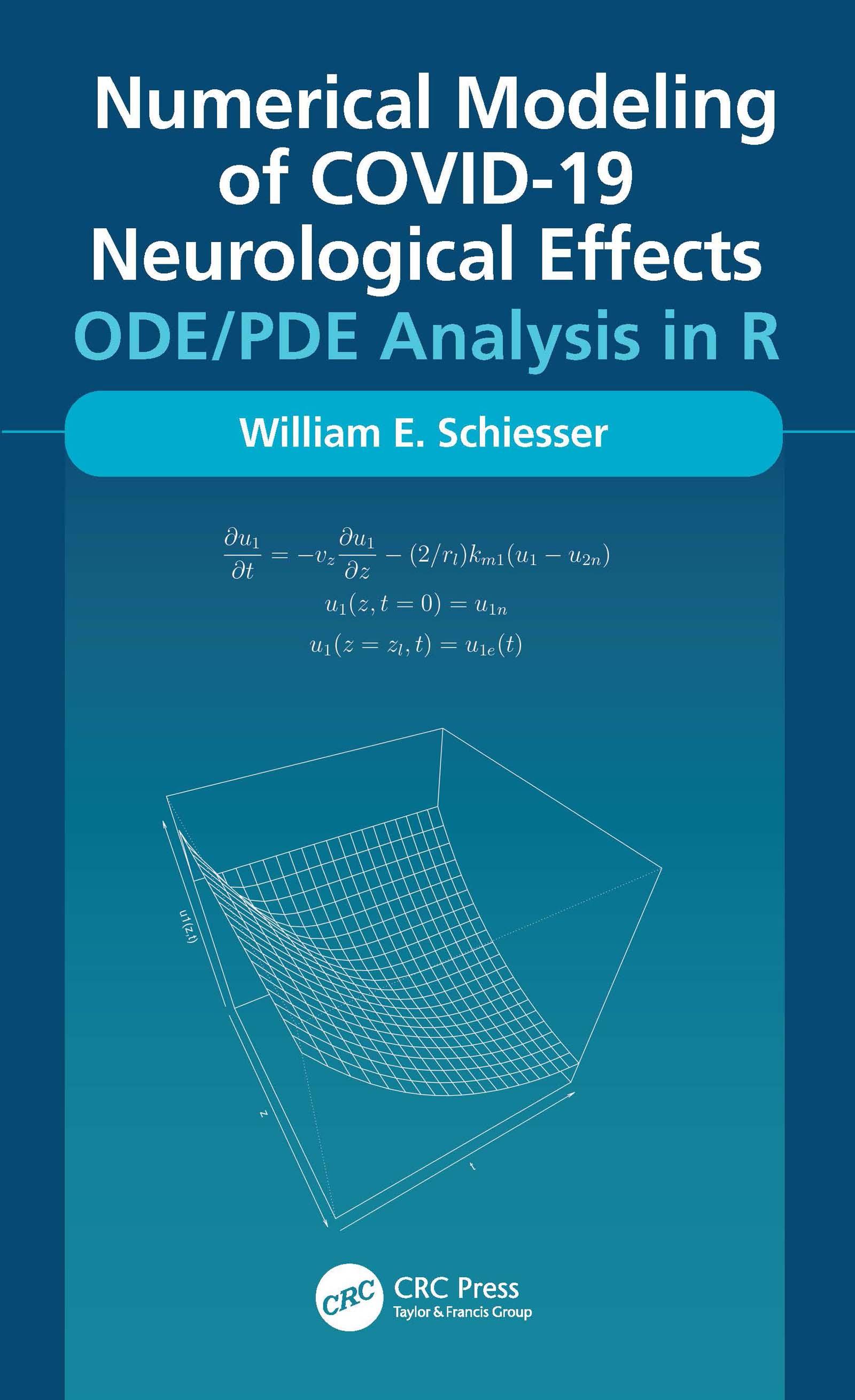
Covid-19 is primarily a respiratory disease which results in impaired oxygenation of blood. The O2-deficient blood then moves through the body, and for the study in this book, the focus is on the blood flowing to the brain. The dynamics of blood flow along the brain capillaries and tissue is modeled as systems of ordinary and partial differential equations (ODE/PDEs).
The ODE/PDE methodology is presented through a series of examples,
1. A basic one PDE model for O2 concentration in the brain capillary blood.
2. A two PDE model for O2 concentration in the brain capillary blood and in the brain tissue, with O2 transport across the blood brain barrier (BBB).
3. The two model extended to three PDEs to include the brain functional neuron cell density.
Cognitive impairment could result from reduced neuron cell density in time and space (in the brain) that follows from lowered O2 concentration (hypoxia).
The computer-based implementation of the example models is presented through routines coded (programmed) in R, a quality, open-source scientific computing system that is readily available from the Internet. Formal mathematics is minimized, e.g., no theorems and proofs. Rather, the presentation is through detailed examples that the reader/researcher/analyst can execute on modest computers. The PDE analysis is based on the method of lines (MOL), an established general algorithm for PDEs, implemented with finite differences.
The routines are available from a download link so that the example models can be executed without having to first study numerical methods and computer coding. The routines can then be applied to variations and extensions of the blood/brain hypoxia models, such as changes in the ODE/PDE parameters (constants) and form of the model equations.
Pay easily by card, Klarna, Apple Pay or Google Pay. Not happy? You always have a 14-day money-back guarantee. Read more in our terms. If you have any questions, email us at hello@memmo.org.
Memmo makes studying easier – wherever you are in the world. We bring your course books and smart study tools together in one place: summaries, quizzes, podcasts and flashcards. Plus Ted, your study buddy who answers anything you wonder. Over 75,000 students already study here – built to help you learn faster and stress less.