
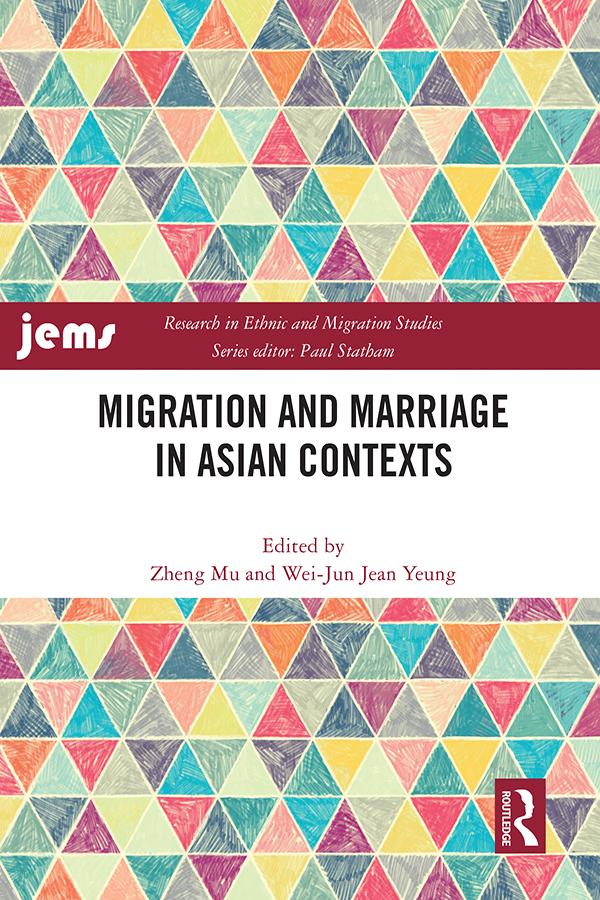
This book analyses how Asian migrants adapt and assimilate into their host societies, and how this assimilation differs across their sociodemographic backgrounds, ethnic profiles, and political contexts. The diversities in Asian migrants’ assimilation trajectories challenge the assumption that given time, migrants will eventually integrate holistically into their host societies.
This book captures the diverse patterns and trajectories of assimilation by going beyond marriage migration to look at how family formation processes are shaped by migration driven by reasons other than marriage. Using quantitative, qualitative, and mixed-method analyses, not only does this book uncover the nuances of the link between marriage and migration, but it also widens methodological repertoires in research on marriage and migration. It also captures various social outcomes that may have been influenced by migration, including migrants’ economic well-being, cultural assimilation, subjective well-being, and gender inequality vis-à-vis marriages. This book further embeds the studies in the Asian contexts by drawing on individual countries’ unique policies relevant to cross-cultural marriages, the persistent impacts of extended families, the patriarchal traditions, and systems of religion and caste.
The chapters in this book were originally published as a special issue of the Journal of Ethnic and Migration Studies.
Pay easily by card, Klarna, Apple Pay or Google Pay. Not happy? You always have a 14-day money-back guarantee. Read more in our terms. If you have any questions, email us at hello@memmo.org.
Memmo makes studying easier – wherever you are in the world. We bring your course books and smart study tools together in one place: summaries, quizzes, podcasts and flashcards. Plus Ted, your study buddy who answers anything you wonder. Over 50,000 students already study here – built to help you learn faster and stress less.