
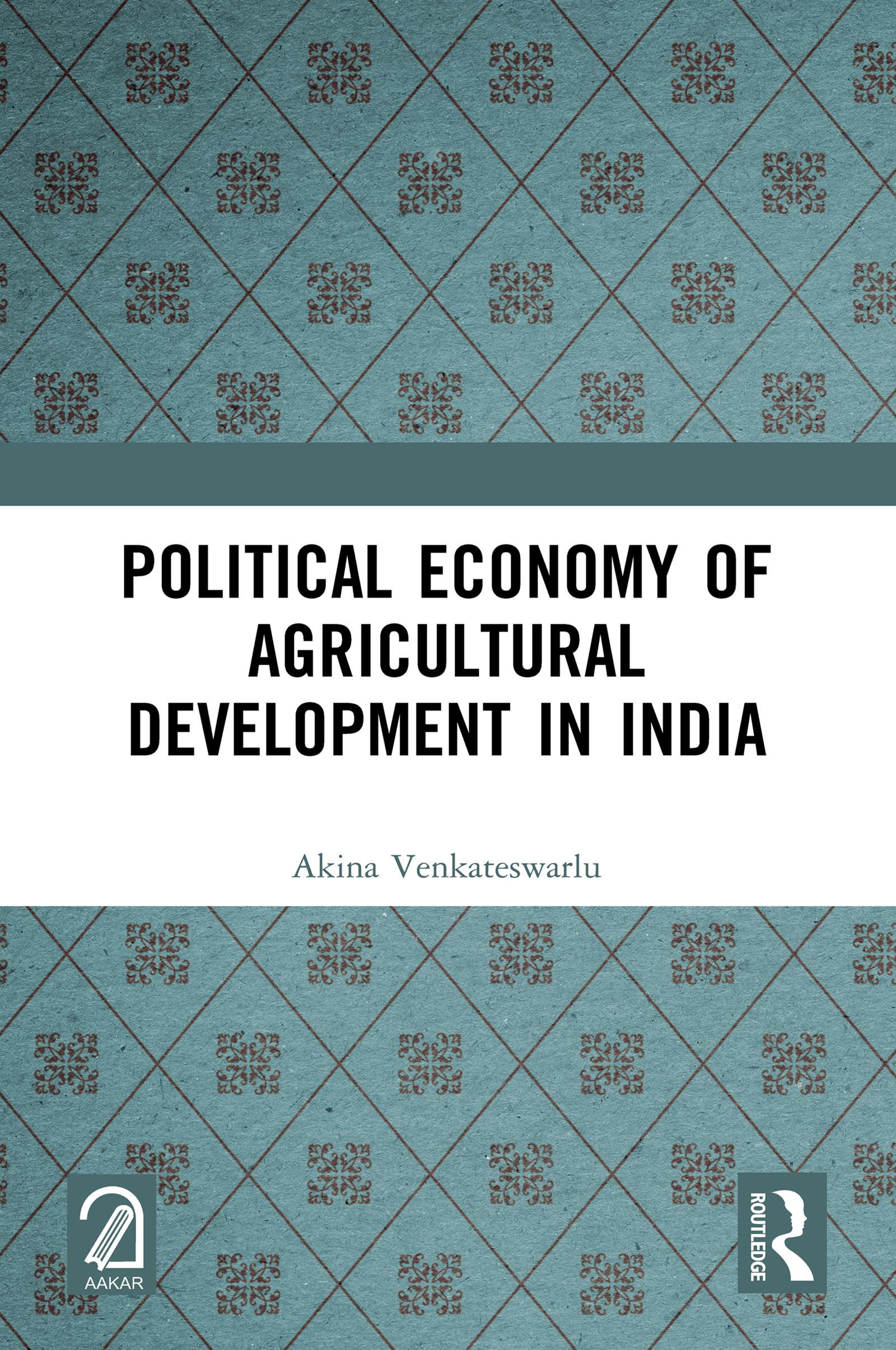
The book covers Indian agricultural development from the colonial to the present period. It examines how ruling class political ideology determined the agricultural policies from colonial rule. It considers both quantitative and qualitative aspects in all periods: colonial period to pre-green revolution phase, post-green revolution phase (early and late stages) and post-globalisation phase after 1991. India has achieved the ability to maintain food security, through enough food grain buffer stocks to meet the enormous public distribution system. But, with India’s entry into WTO in 1994, euphoria has been created among all types of farmers to adopt commercial crops like cotton cost-intensive inputs. Even food grain crops are grown through use of costly irrigation and chemicalised inputs. But they lacked remunerative prices, and so farmers began to commit suicides, which crossed 3.5 lakh. Government of India attributed this agrarian crisis to the technology fatigue and gave scope for second green revolution (GR-II). GR-I was achieved by public sector enterprise, whereas the GR-II as gene revolution is a result of private sector enterprise/MNCs. There is fear that opening up of the sector may lead to handover of the family farms to big agri-multinationals. GOI’s proposal to double farmers’ income by 2022 is feasible only when the problems, being faced by small, marginal and tenant farmers, are addressed in agricultural marketing, credit and extension services. Now, it is time to go for suitable forms of cooperative/collective agriculture, as 85 percent of total cultivators are the small and marginal farmers.
This book is co-published with Aakar Books, New Delhi. Taylor & Francis does not sell or distribute the print versions of this book in India, Pakistan, Nepal, Bhutan, Bangladesh and Sri Lanka.
Pay easily by card, Klarna, Apple Pay or Google Pay. Not happy? You always have a 14-day money-back guarantee. Read more in our terms. If you have any questions, email us at hello@memmo.org.
Memmo makes studying easier – wherever you are in the world. We bring your course books and smart study tools together in one place: summaries, quizzes, podcasts and flashcards. Plus Ted, your study buddy who answers anything you wonder. Over 50,000 students already study here – built to help you learn faster and stress less.