
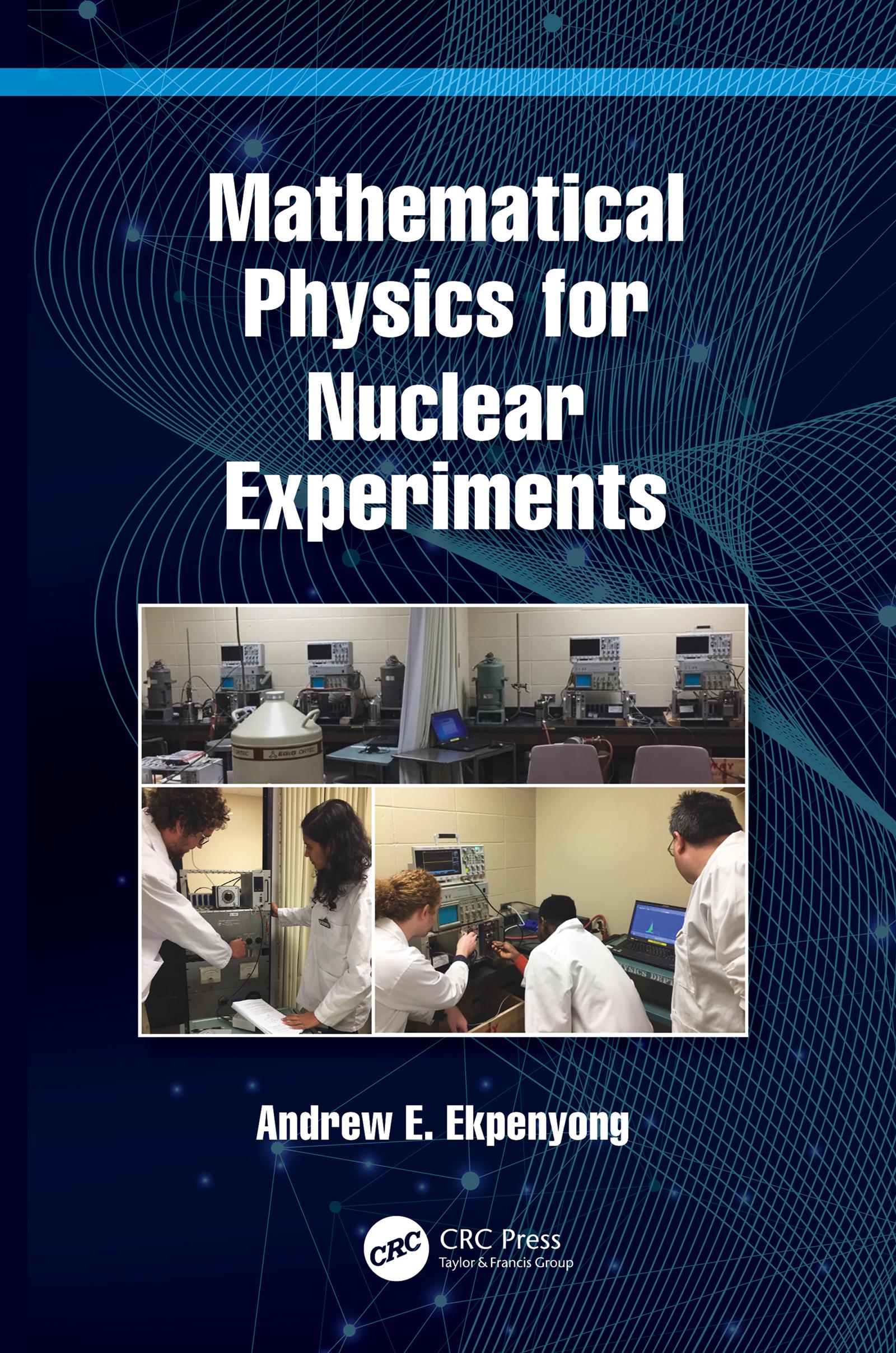
Mathematical Physics for Nuclear Experiments presents an accessible introduction to the mathematical derivations of key equations used in describing and analysing results of typical nuclear physics experiments. Instead of merely showing results and citing texts, crucial equations in nuclear physics such as the Bohr’s classical formula, Bethe’s quantum mechanical formula for energy loss, Poisson, Gaussian and Maxwellian distributions for radioactive decay, and the Fermi function for beta spectrum analysis, among many more, are presented with the mathematical bases of their derivation and with their physical utility.
This approach provides readers with a greater connection between the theoretical and experimental sides of nuclear physics. The book also presents connections between well-established results and ongoing research. It also contains figures and tables showing results from the author’s experiments and those of his students to demonstrate experimental outcomes.
This is a valuable guide for advanced undergraduates and early graduates studying nuclear instruments and methods, medical and health physics courses as well as experimental particle physics courses.
Key features
- Contains over 500 equations connecting theory with experiments.
- Presents over 80 examples showing physical intuition and illustrating concepts.
- Includes 80 exercises, with solutions, showing applications in nuclear and medical physics.
Pay easily by card, Klarna, Apple Pay or Google Pay. Not happy? You always have a 14-day money-back guarantee. Read more in our terms. If you have any questions, email us at hello@memmo.org.
Memmo makes studying easier – wherever you are in the world. We bring your course books and smart study tools together in one place: summaries, quizzes, podcasts and flashcards. Plus Ted, your study buddy who answers anything you wonder. Over 50,000 students already study here – built to help you learn faster and stress less.