
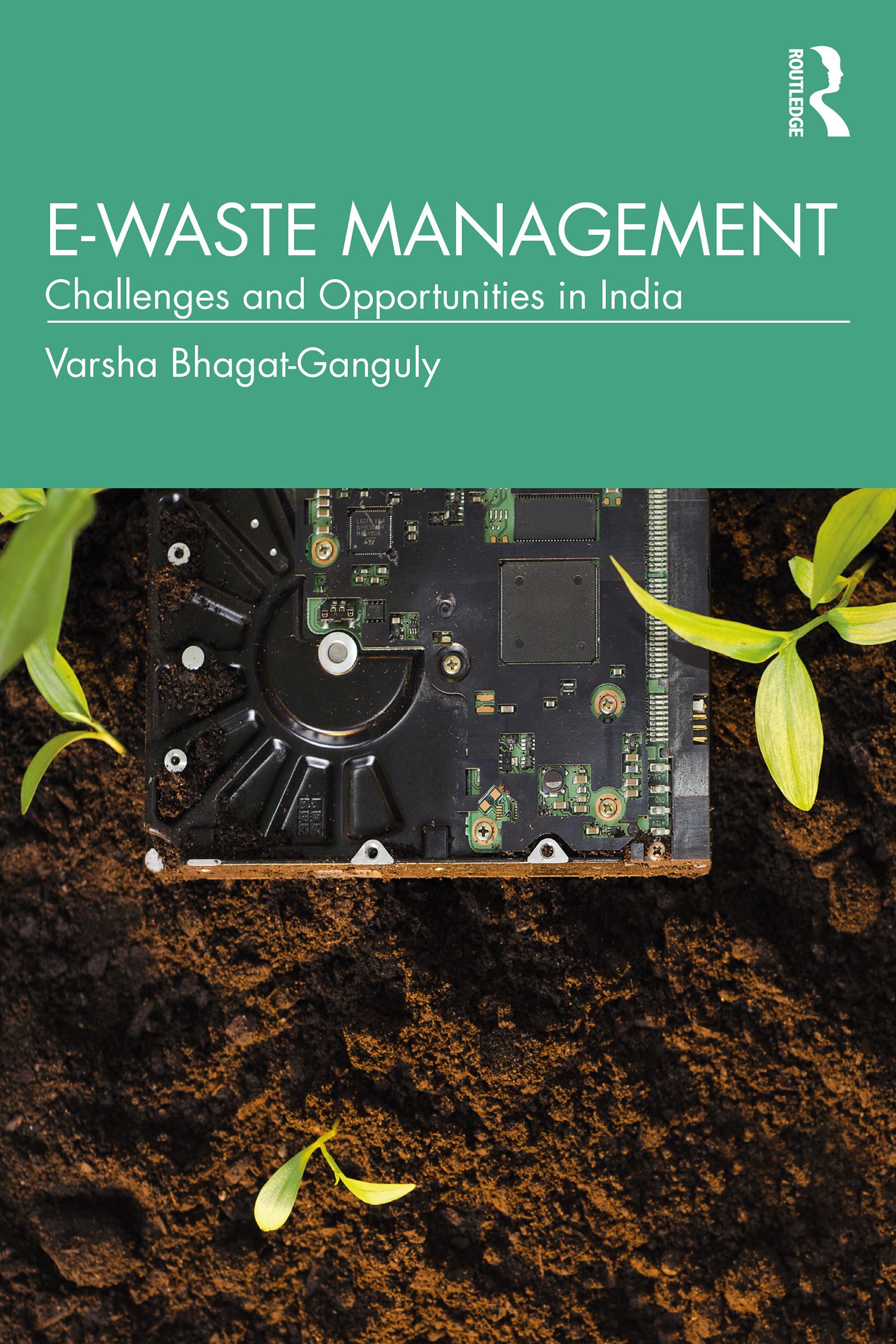
This book offers an extensive review of e-waste management in India, the world’s third‑largest producer of waste from electrical and electronic equipment. With a focus on the evolution of legalframeworks in India and the world, it presents impacts and outcomes; challenges and opportunities; and management strategies and practices to deal with e-waste. First of its kind, the book examines relevant concepts and issues from across 15 disciplines and six areas of policy making and will serve as a comprehensive knowledge base on electronic waste in India. It links key themes to the global context of Sustainable Development Goals and explores the convergence with technological, infrastructural, and social initiatives in e-waste management.
A range of topics are discussed, such as resource efficiency policies; circular economy; toxicity; technicalities and complexities of e-waste management including role of the informal sector and need for recognising social and human costs in policy making. The book deals with the role of statistics; legal trends and reforms; linkages with green Agenda 2030 and UN initiatives; implementation of Extended Producer Responsibility (EPR); environmental factors; business prospects; consequences on human health; Life Cycle Impact Assessment; the ‘six Rs’ (Responsible use, Repair, Refurbish, Recycle, Recover and Reuse); recycling practices and problems, material flow and informal sector in trade value chain; fostering partnership between formal-informal sectors; safe disposal; alternatives to landfilling; role of jurisprudence and regulatory bodies; and education and awareness. It also includes a survey of pan-India initiatives and trajectories of law-driven initiatives for effective e-waste management along with responses from industries and producers.
Timely and essential, this volume will be useful to scholars and researchers of environment studies, digital waste management, waste management, development studies, public policy, political ecology, sustainable development, technology and manufacturing, design and instrumentation, environmental and international law, taxation, commerce, electronic industry, economics, business management, metallurgy, and engineering, labour studies, as well as to policymakers, nongovernmental organisations, and interested general readers.
Pay easily by card, Klarna, Apple Pay or Google Pay. Not happy? You always have a 14-day money-back guarantee. Read more in our terms. If you have any questions, email us at hello@memmo.org.
Memmo makes studying easier – wherever you are in the world. We bring your course books and smart study tools together in one place: summaries, quizzes, podcasts and flashcards. Plus Ted, your study buddy who answers anything you wonder. Over 50,000 students already study here – built to help you learn faster and stress less.