
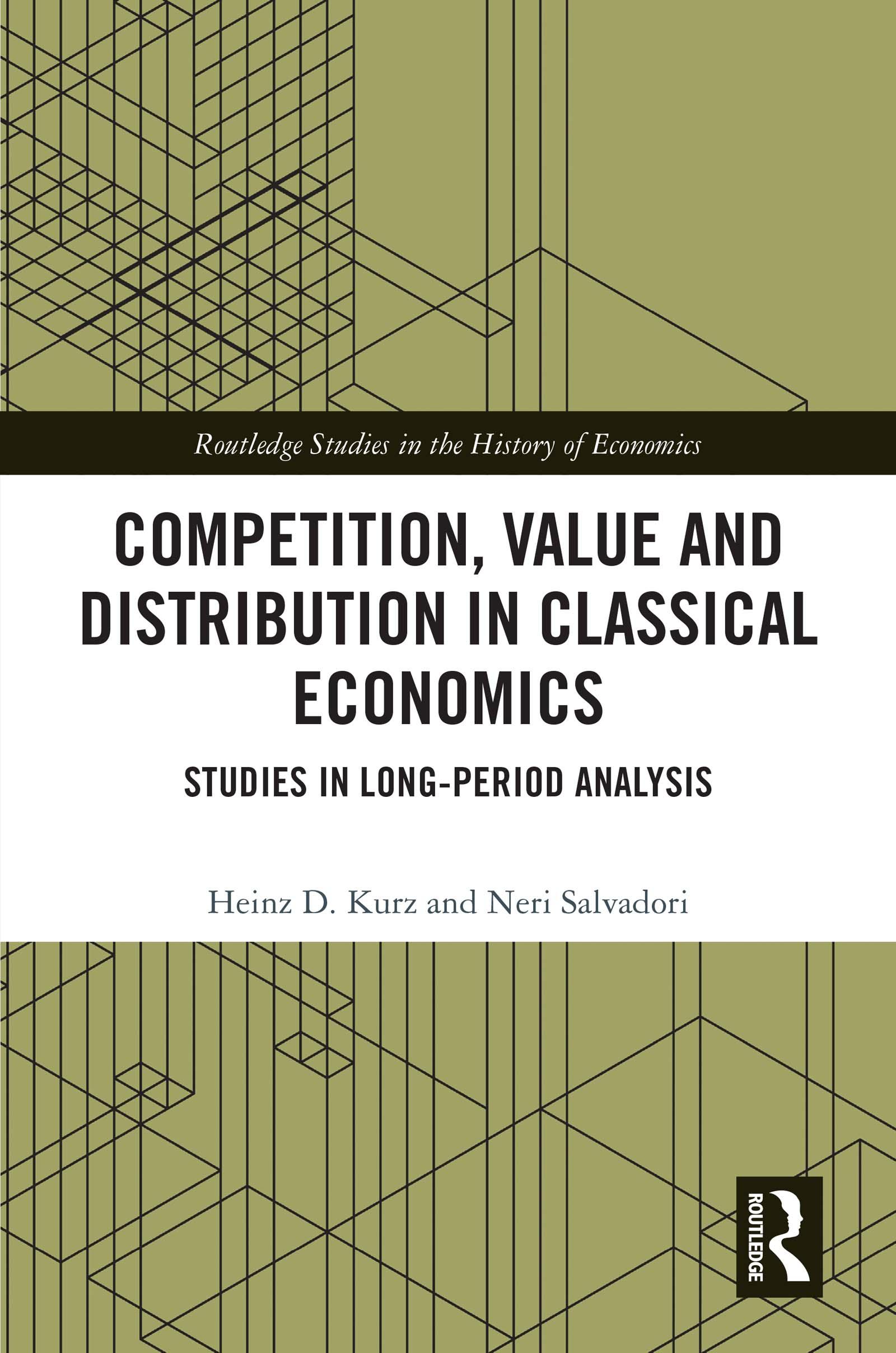
Drawing in particular on the work of Sraffa, Smith, Ricardo and Marx, the essays in this volume explore the characteristic features of the Classical economists’ approach to economic problems, and the renewal of interest in that approach in modern times.
In recent years, new material has been made available on both Sraffa and Marx which have made new insights and interpretations possible. The release of Sraffa’s hitherto unpublished papers and correspondence has led to reconsideration of doctrinal questions such as to what extent Sraffa built upon, or deviated from the analyses of Adam Smith, David Ricardo and other representatives of the classical British school and Karl Marx. A major theme is also to what extent we can today, equipped with Sraffa's insights and analytical tools, re-interpret and develop ideas of classical authors, which they could present only in primitive forms, on technological progress, exhaustible resources and other contemporary issues. On Marx, the publication of the MEGA2 edition of the works, papers and correspondence of Marx and Engels also gives rise to a reconsideration of this relationship, given Marx's disenchantment with some of his own work and return to ideas advocated by Ricardo, especially as regards the long-term tendency of the rate of profits. Finally, the classical notion of competition and monopoly deserve to be scrutinized carefully again and frequent misinterpretations in the literature refuted.
This volume is vital reading for scholars of classical economics, Marx and Sraffa, and the history of economic thought more broadly. It also deals with issues in the areas of machinery and technical progress, joint production, and economic development and growth.
Pay easily by card, Klarna, Apple Pay or Google Pay. Not happy? You always have a 14-day money-back guarantee. Read more in our terms. If you have any questions, email us at hello@memmo.org.
Memmo makes studying easier – wherever you are in the world. We bring your course books and smart study tools together in one place: summaries, quizzes, podcasts and flashcards. Plus Ted, your study buddy who answers anything you wonder. Over 50,000 students already study here – built to help you learn faster and stress less.