
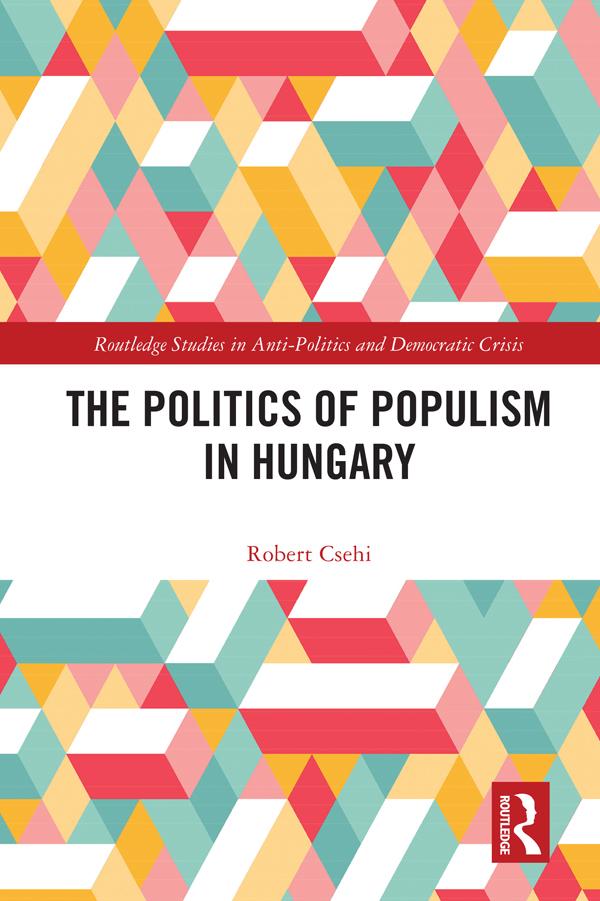
The book assesses the development of the Orbán regime in Hungary after 2010 through analyzing the polity-politics-policy impacts from a perspective of populism as an ideology focusing on discourse and actual decisions.
By closely scrutinizing political narratives, actual decisions and survey data, this volume offers a systematic analysis of the impact of populism on the polity-politics-policy aspects of the political in Hungary after 2010. It analyzes the uses of constitutionalism and discriminatory legalism, the changes in the quality of democracy, the government’s relationship with media and journalism, its influence over the party system and EU politics, and its approach to family and cultural policies. While each chapter in the volume describes the findings in response to the corresponding literature highlighting the added value of the individual analyses, the book interprets the overall results under the notion of "smart populism" where the moral definition of "the people" allows for little political opposition, "the elite" is selected based on its multifaceted applicability for a political narrative and "the will of the people" is determined from above. The volume also suggests responses to "smart populism".
The book will be of particular interest to students and scholars of democracy, party politics the rise of populism and contemporary Hungarian politics.
Pay easily by card, Klarna, Apple Pay or Google Pay. Not happy? You always have a 14-day money-back guarantee. Read more in our terms. If you have any questions, email us at hello@memmo.org.
Memmo makes studying easier – wherever you are in the world. We bring your course books and smart study tools together in one place: summaries, quizzes, podcasts and flashcards. Plus Ted, your study buddy who answers anything you wonder. Over 50,000 students already study here – built to help you learn faster and stress less.