
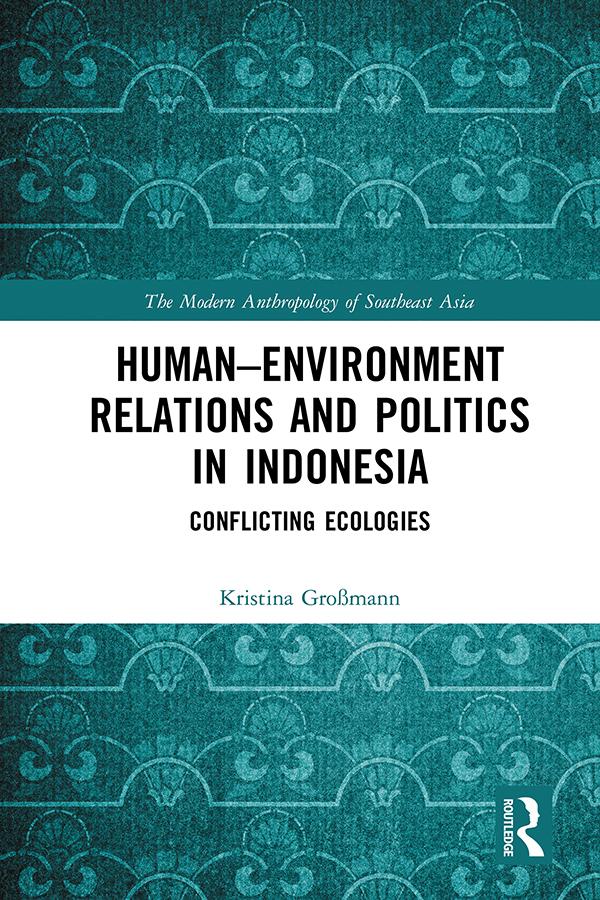
This book analyses how people in Kalimantan, the Indonesian part of the island of Borneo, relate to their environment in different political and historical contexts.
Drawing on multi-sited ethnographic studies of Dayak people, the indigenous inhabitants of Borneo, the book examines how human-environment relationships differ and collide. These "conflicting ecologies" are based on people's relation to the "environment", which encompasses the non-human realm in the widest sense, including forests, rivers, land, natural resources, animals and spirits. The author argues that relationality and power are decisive factors for the understanding and analysis of peoples’ ecologies. The book integrates different theoretical approaches, sheds light upon the environmental transformation taking place in Indonesia, as well as the social exclusion it entails, and highlights the conceptual shortcomings of universalistic concepts of human-environment relations.
An exploration of evolving human-nature relations, this book will be of interest to academics studying political ecology, environmental anthropology, sustainability sciences, political sciences, development studies, human geography, human ecology, Southeast Asian studies, and Asian studies.
Pay easily by card, Klarna, Apple Pay or Google Pay. Not happy? You always have a 14-day money-back guarantee. Read more in our terms. If you have any questions, email us at hello@memmo.org.
Memmo makes studying easier – wherever you are in the world. We bring your course books and smart study tools together in one place: summaries, quizzes, podcasts and flashcards. Plus Ted, your study buddy who answers anything you wonder. Over 50,000 students already study here – built to help you learn faster and stress less.