
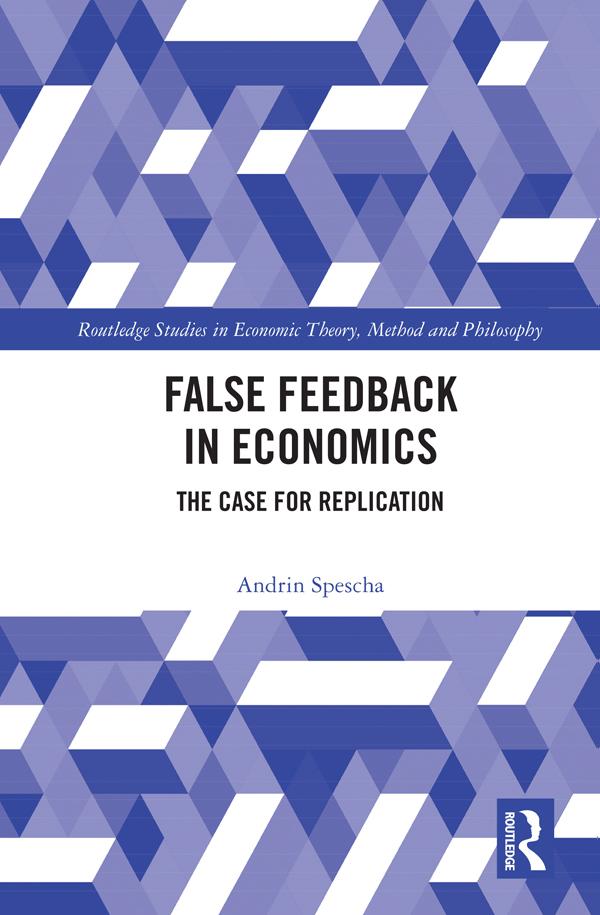
This book investigates why economics makes less visible progress over time than scientific fields with a strong practical component, where interactions with physical technologies play a key role. The thesis of the book is that the main impediment to progress in economics is "false feedback", which it defines as the false result of an empirical study, such as empirical evidence produced by a statistical model that violates some of its assumptions. In contrast to scientific fields that work with physical technologies, false feedback is hard to recognize in economics. Economists thus have difficulties knowing where they stand in their inquiries, and false feedback will regularly lead them in the wrong directions.
The book searches for the reasons behind the emergence of false feedback. It thereby contributes to a wider discussion in the field of metascience about the practices of researchers when pursuing their daily business. The book thus offers a case study of metascience for the field of empirical economics.
The main strength of the book are the numerous smaller insights it provides throughout. The book delves into deep discussions of various theoretical issues, which it illustrates by many applied examples and a wide array of references, especially to philosophy of science. The book puts flesh on complicated and often abstract subjects, particularly when it comes to controversial topics such as p-hacking.
The reader gains an understanding of the main challenges present in empirical economic research and also the possible solutions. The main audience of the book are all applied researchers working with data and, in particular, those who have found certain aspects of their research practice problematic.
Pay easily by card, Klarna, Apple Pay or Google Pay. Not happy? You always have a 14-day money-back guarantee. Read more in our terms. If you have any questions, email us at hello@memmo.org.
Memmo makes studying easier – wherever you are in the world. We bring your course books and smart study tools together in one place: summaries, quizzes, podcasts and flashcards. Plus Ted, your study buddy who answers anything you wonder. Over 50,000 students already study here – built to help you learn faster and stress less.