
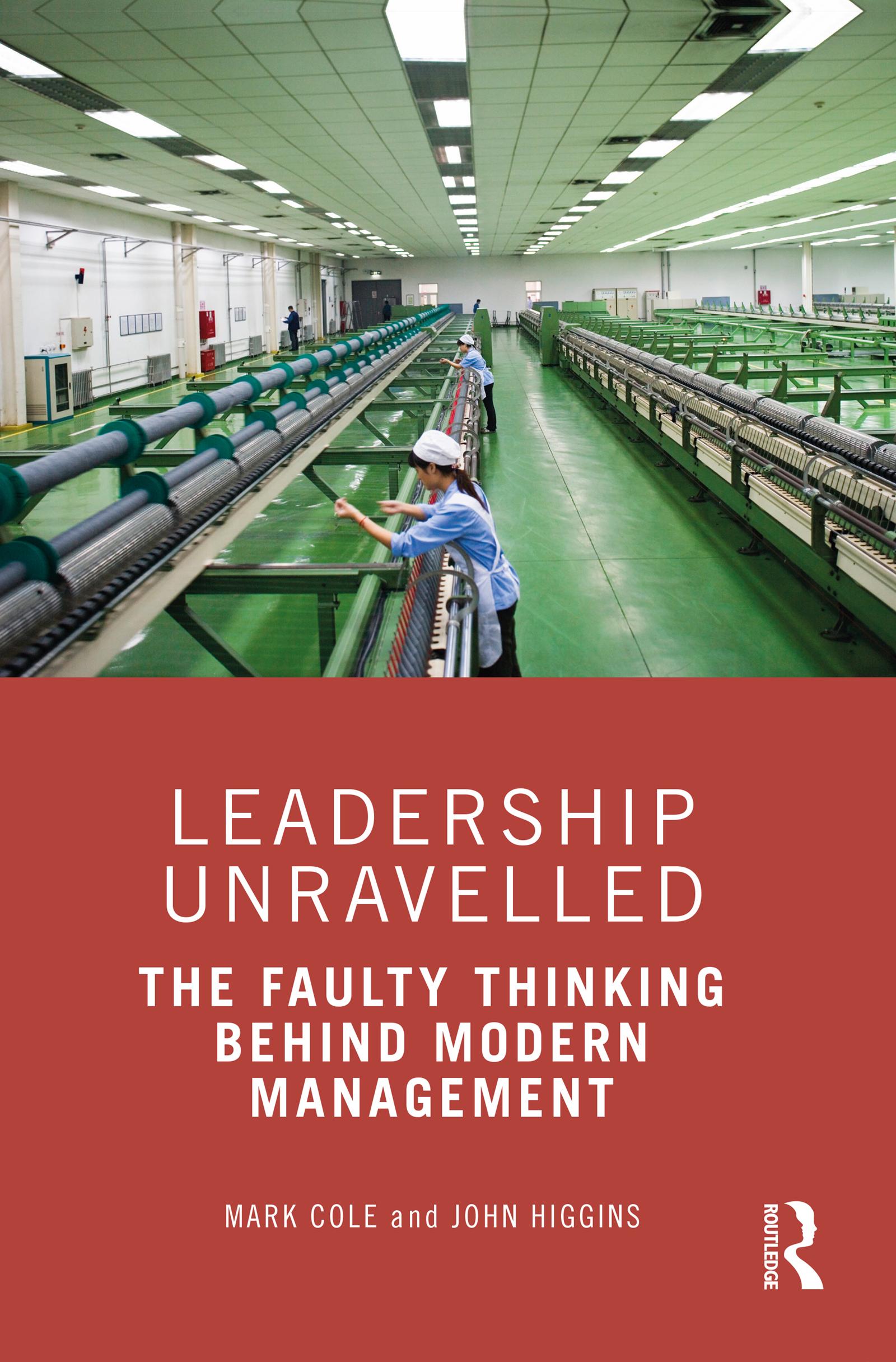
Why is it that leaders – in social, political, and (most importantly) organisational contexts – are seemingly unable to address meaningfully the wicked problems and complex challenges that we currently face? There’s enormous busyness around reconfiguring departments and adopting ‘transformational’ operating models, but in general plus ca change, plus la meme chose.
Eyewatering amounts of treasure and time are spent in corporate life on leadership development, with people working hard to try and demonstrate that something useful has happened as a result. An entire pseudo-science has emerged to try and prove its worth, in part to justify the economic dividend that goes to those who make it to the upper levels of positional power. The fetishisation of leadership, especially strong leadership, fills our news outlets holding up carefully distorted images of great men (leadership is still deeply gendered) from across the worlds of politics, business, and sports. This book explores the persistently disappeared and unacknowledged constraints that inhibit leaders in every context. It argues that these constraints – defined in this volume in terms of five organisational paradoxes and six management myths – are found at large in society and are especially impactful in organisational life.
By calling attention to, and exploring in rigorous detail, these paradoxes and myths, this book helps leaders, and the leadership systems they are part of, to wriggle free of the tacit assumptions that lock them into a cul-de-sac of simplistic prescription and heroic individualism. Once these mind-forged manacles are removed, new forms of leadership practice become possible, ones that are fit for purpose in engaging with a world facing systemic crisis and existential risk.
This book is essential reading for leaders and managers at all levels looking for solutions to traditionally simplistic leadership practice and who want to affect systemic change. It will be beneficial to all those in the world of leadership development including business schools and HR departments.
Pay easily by card, Klarna, Apple Pay or Google Pay. Not happy? You always have a 14-day money-back guarantee. Read more in our terms. If you have any questions, email us at hello@memmo.org.
Memmo makes studying easier – wherever you are in the world. We bring your course books and smart study tools together in one place: summaries, quizzes, podcasts and flashcards. Plus Ted, your study buddy who answers anything you wonder. Over 75,000 students already study here – built to help you learn faster and stress less.