
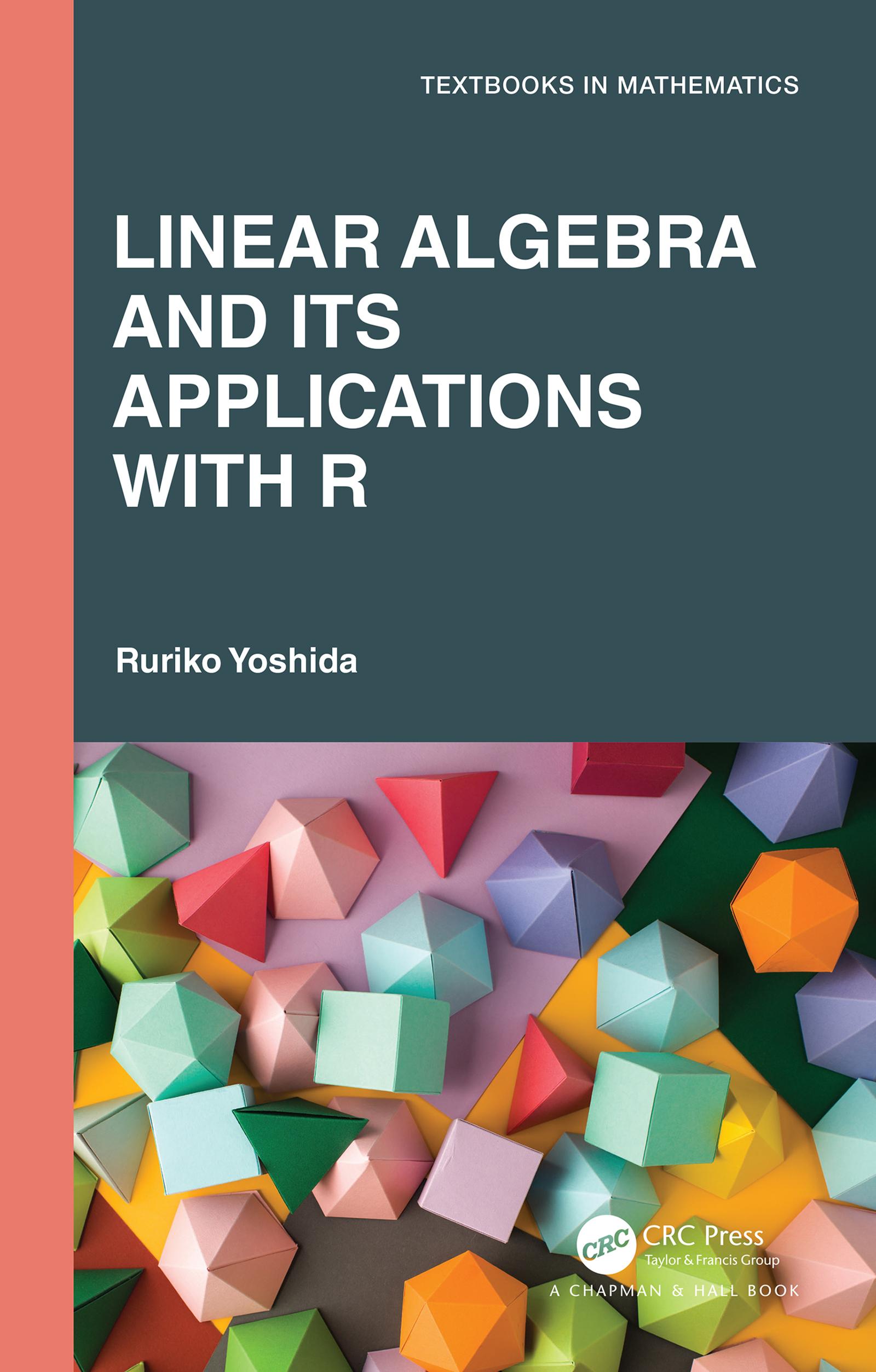
This book developed from the need to teach a linear algebra course to students focused on data science and bioinformatics programs. These students tend not to realize the importance of linear algebra in applied sciences, since traditional linear algebra courses tend to cover mathematical contexts but not the computational aspect of linear algebra or its applications to data science and bioinformatics.
The author presents the topics in a traditional course, yet offers lectures as well as lab exercises on simulated and empirical data sets. This textbook provides students a theoretical basis which can then be applied to the practical R and Python problems, providing the tools needed for real-world applications.
Each section starts with working examples to demonstrate how tools from linear algebra can help solve problems in applied sciences. These exercises start from easy computations, such as computing determinants of matrices, to practical applications on simulated and empirical data sets with R so that students learn how to get started with R, along with computational examples in each section, and then students learn how to apply what they've learned to problems in applied sciences.
This book is designed from first principles to demonstrate the importance of linear algebra through working computational examples with R and Python, including tutorials on how to install R in the Appendix. If a student has never seen R, they can get started without any additional help.
Since Python is one of the most popular languages in data science, optimization, and computer science, code supplements are available for students who feel more comfortable with Python. R is used primarily for computational examples to develop students’ practical computational skills.
About the Author:
Dr. Ruriko Yoshida is an Associate Professor of Operations Research at the Naval Postgraduate School. She received her PhD in Mathematics from the University of California, Davis. Her research topics cover a wide variety of areas: applications of algebraic combinatorics to statistical problems such as statistical learning on non-Euclidean spaces, sensor networks, phylogenetics, and phylogenomics. She teaches courses in statistics, stochastic models, probability, and data science.
Pay easily by card, Klarna, Apple Pay or Google Pay. Not happy? You always have a 14-day money-back guarantee. Read more in our terms. If you have any questions, email us at hello@memmo.org.
Memmo makes studying easier – wherever you are in the world. We bring your course books and smart study tools together in one place: summaries, quizzes, podcasts and flashcards. Plus Ted, your study buddy who answers anything you wonder. Over 75,000 students already study here – built to help you learn faster and stress less.