
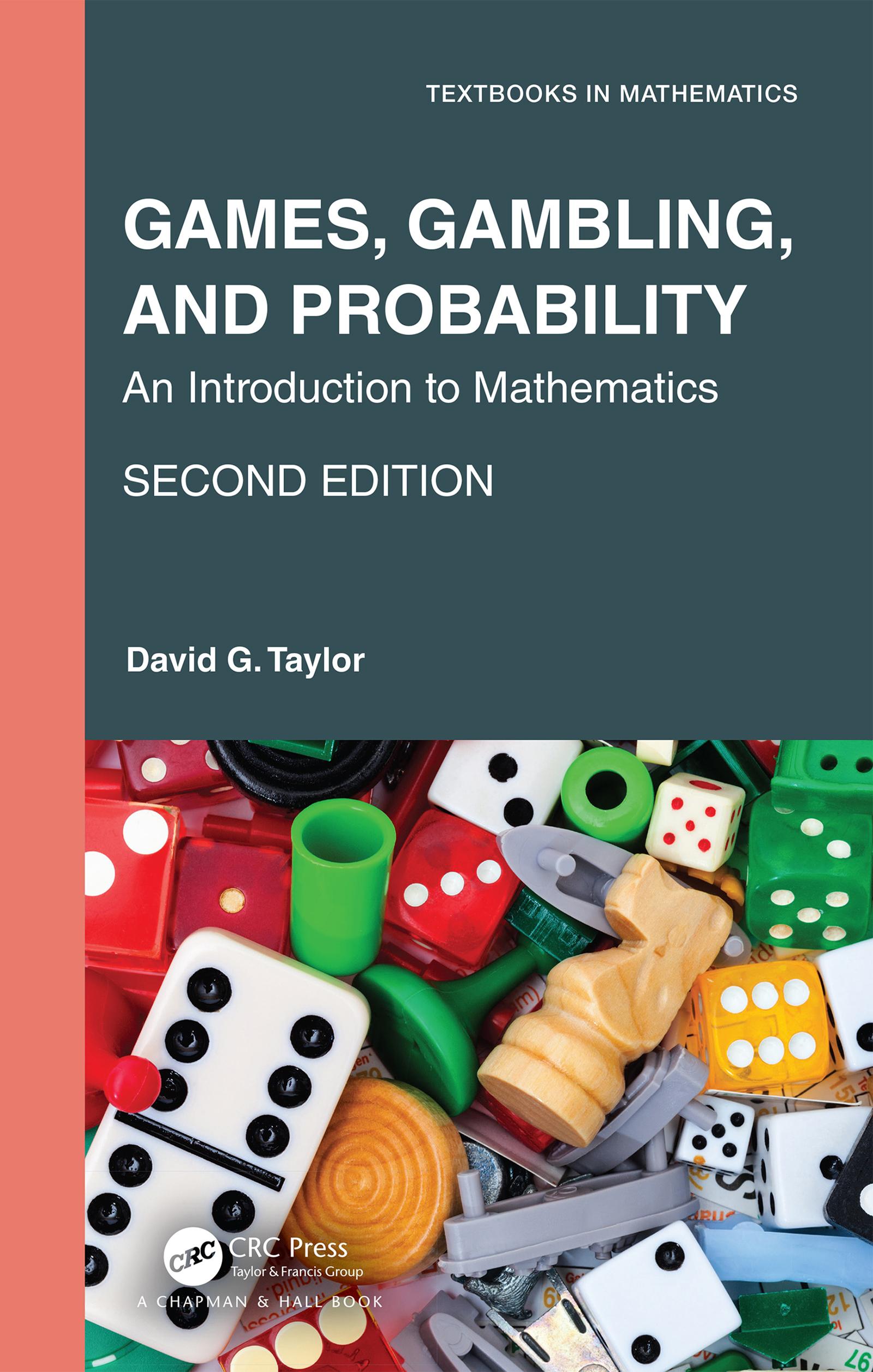
Many experiments have shown the human brain generally has very serious problems dealing with probability and chance. A greater understanding of probability can help develop the intuition necessary to approach risk with the ability to make more informed (and better) decisions.
The first four chapters offer the standard content for an introductory probability course, albeit presented in a much different way and order. The chapters afterward include some discussion of different games, different "ideas" that relate to the law of large numbers, and many more mathematical topics not typically seen in such a book. The use of games is meant to make the book (and course) feel like fun!
Since many of the early games discussed are casino games, the study of those games, along with an understanding of the material in later chapters, should remind you that gambling is a bad idea; you should think of placing bets in a casino as paying for entertainment. Winning can, obviously, be a fun reward, but should not ever be expected.
Changes for the Second Edition:
- New chapter on Game Theory
- New chapter on Sports Mathematics
- The chapter on Blackjack, which was Chapter 4 in the first edition, appears later in the book.
- Reorganization has been done to improve the flow of topics and learning.
- New sections on Arkham Horror, Uno, and Scrabble have been added.
- Even more exercises were added!
The goal for this textbook is to complement the inquiry-based learning movement. In my mind, concepts and ideas will stick with the reader more when they are motivated in an interesting way. Here, we use questions about various games (not just casino games) to motivate the mathematics, and I would say that the writing emphasizes a "just-in-time" mathematics approach. Topics are presented mathematically as questions about the games themselves are posed.
Table of Contents
Preface
1. Mathematics and Probability
2. Roulette and Craps: Expected Value
3. Counting: Poker Hands
4. More Dice: Counting and Combinations, and Statistics
5. Game Theory: Poker Bluffing and Other Games
6. Probability/Stochastic Matrices: Board Game Movement
7. Sports Mathematics: Probability Meets Athletics
8. Blackjack: Previous Methods Revisited
9. A Mix of Other Games
10. Betting Systems: Can You Beat the System?
11. Potpourri: Assorted Adventures in Probability
Appendices
Tables
Answers and Selected Solutions
Bibliography
Biography
Dr. David G. Taylor is a professor of mathematics and an associate dean for academic affairs at Roanoke College in southwest Virginia. He attended Lebanon Valley College for his B.S. in computer science and mathematics and went to the University of Virginia for his Ph.D. While his graduate school focus was on studying infinite dimensional Lie algebras, he started studying the mathematics of various games in order to have a more undergraduate-friendly research agenda. Work done with two Roanoke College students, Heather Cook and Jonathan Marino, appears in this book! Currently he owns over 100 different board games and enjoys using probability in his decision-making while playing most of those games. In his spare time, he enjoys reading, cooking, coding, playing his board games, and spending time with his six-year-old dog Lilly.
Pay easily by card, Klarna, Apple Pay or Google Pay. Not happy? You always have a 14-day money-back guarantee. Read more in our terms. If you have any questions, email us at hello@memmo.org.
Memmo makes studying easier – wherever you are in the world. We bring your course books and smart study tools together in one place: summaries, quizzes, podcasts and flashcards. Plus Ted, your study buddy who answers anything you wonder. Over 75,000 students already study here – built to help you learn faster and stress less.