
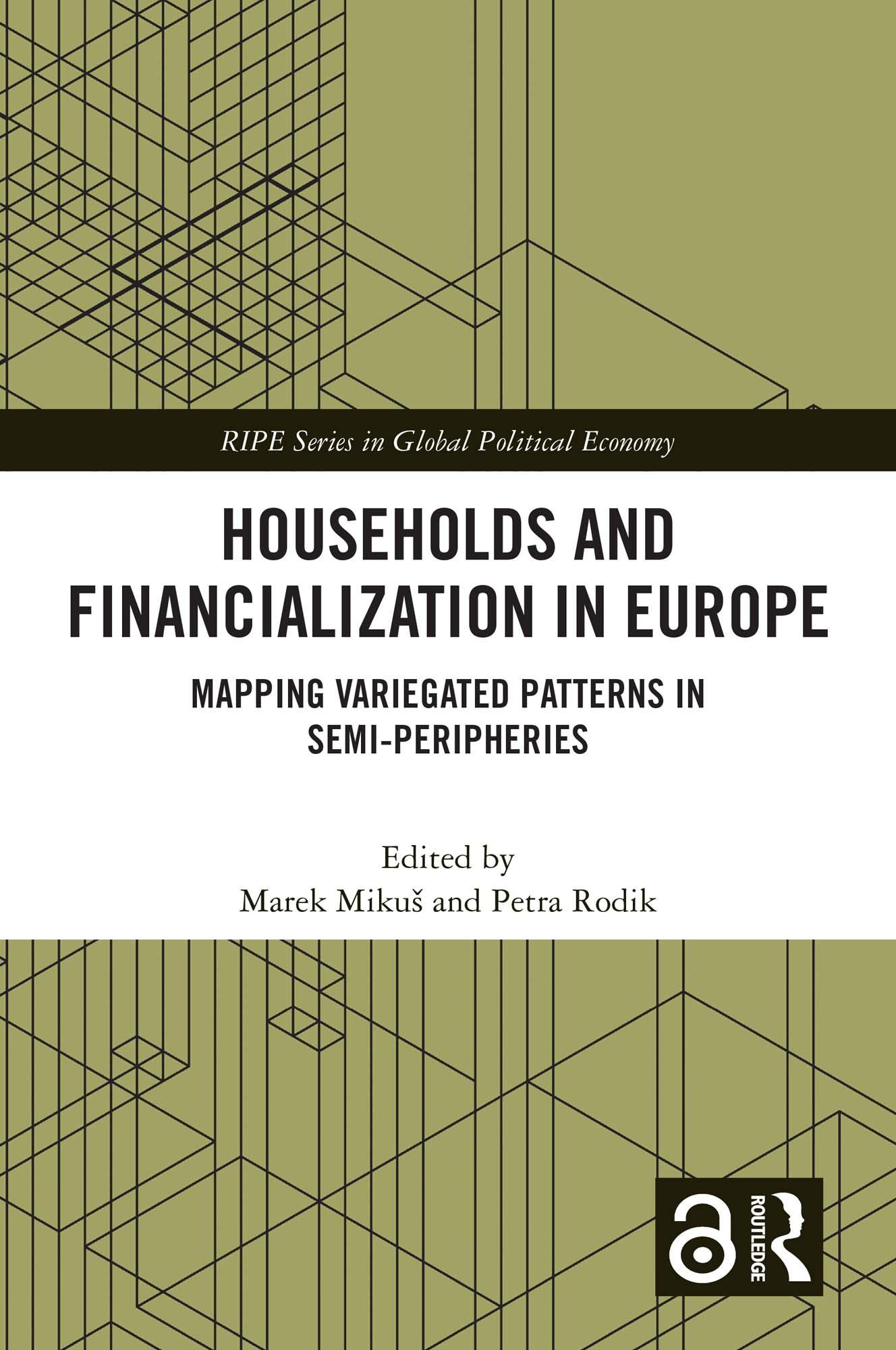
Households and Financialization in Europe develops a processual, relational and critical transdisciplinary approach to household financialization in Europe, utilizing a range of national and local case studies. It does so by drawing on debates in Marxist, feminist and radical IPE, anthropology and other fields.
The book explores the household as simultaneously a micro-level social institution specializing in social reproduction, distribution and other activities; a building bloc of larger economic and social structures; and an object of multiple systems of power/knowledge. Putting this conceptualization to use in original research, the authors identify geographically and historically situated ways in which financialization transforms households and their relationships with the wider economy and society. The book traces these transformations in case studies of variegated financialization in Eastern and Southern European (semi-) peripheries where households have faced particularly severe financial issues since the global financial crisis, such as over-indebtedness and asset devaluation. Key themes recurring throughout the book include: the key role of housing in household financialization, the co-constitutive relationship between financialization and social and spatial inequalities, specific patterns in the relations of financial actors and households in semi-peripheries, and the implications of semi-peripheral forms of real and financial accumulation for household financialization.
With its transdisciplinary approach, this book will be of great interest to students and scholars of finance, financialization, household economics, international and global political economy, uneven development, economic anthropology, and economic sociology.
The Introduction of this book is freely available as a downloadable Open Access PDF at http://www.taylorfrancis.com under a Creative Commons Attribution CC-BY 4.0 license.
Pay easily by card, Klarna, Apple Pay or Google Pay. Not happy? You always have a 14-day money-back guarantee. Read more in our terms. If you have any questions, email us at hello@memmo.org.
Memmo makes studying easier – wherever you are in the world. We bring your course books and smart study tools together in one place: summaries, quizzes, podcasts and flashcards. Plus Ted, your study buddy who answers anything you wonder. Over 50,000 students already study here – built to help you learn faster and stress less.