
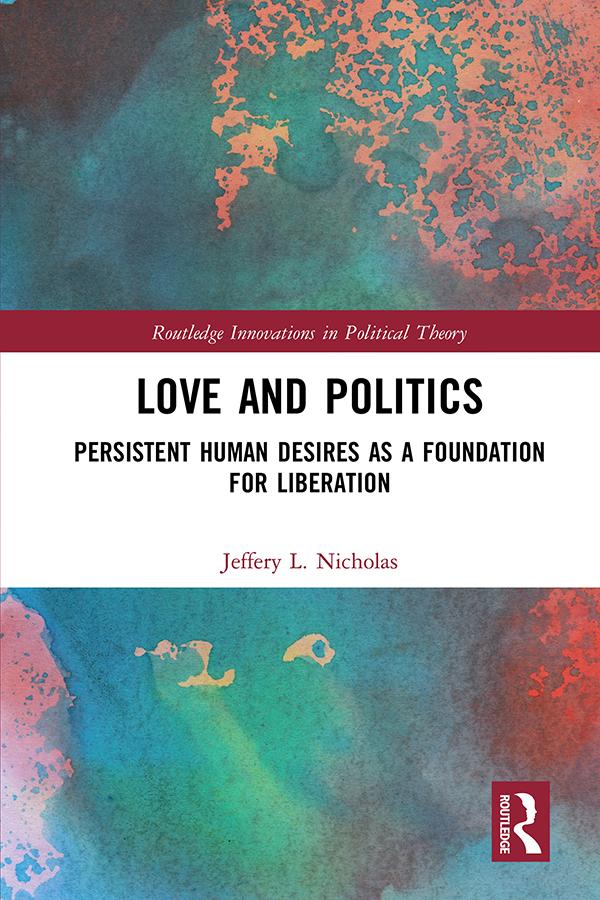
In, Love and Politics Jeffery L. Nicholas argues that Eros is the final rejection of an alienated life, in which humans are prevented from developing their human powers; Eros, in contrast, is an overflowing of acting into new realities and new beauties, a world in which human beings extend their powers and senses.
Nicholas uniquely interprets Alasdair MacIntyre’s Revolutionary Aristotelianism as a response to alienation defined as the divorce of fact from value. However, this account cannot address alienation in the form of the oppression of women or people of color. Importantly, it fails to acknowledge the domination of nature that blackens the heart of alienated life. Alienation must be seen as a separation of the human from nature. Nicholas turns to Aristotle, first, to uncover the way his philosophy embodies a divorce of human from nature, then to reconstruct the essential elements of Aristotle’s metaphysics to defend a philosophical anthropology based on Eros.
Love and Politics: Persistent Human Desires as a Foundation for Liberation presents a critical theory that synthesizes MacIntyre’s Revolutionary Aristotelianism, Frankfurt School Critical Theory, and Social Reproduction Theory. It will be of great interest to political theorists and philosophers.
Pay easily by card, Klarna, Apple Pay or Google Pay. Not happy? You always have a 14-day money-back guarantee. Read more in our terms. If you have any questions, email us at hello@memmo.org.
Memmo makes studying easier – wherever you are in the world. We bring your course books and smart study tools together in one place: summaries, quizzes, podcasts and flashcards. Plus Ted, your study buddy who answers anything you wonder. Over 50,000 students already study here – built to help you learn faster and stress less.