
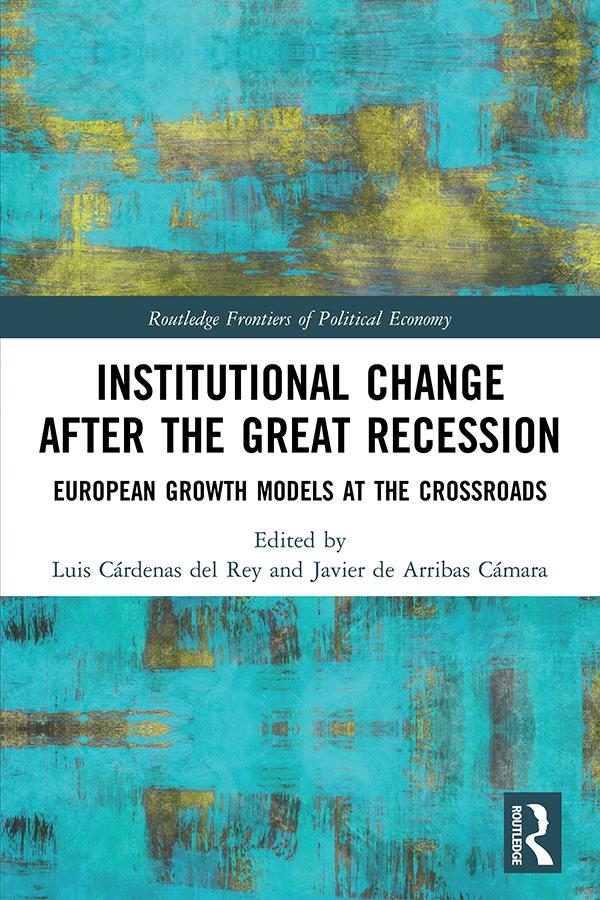
This book combines demand-led growth models and the institutionalist approach, in order to explain the macroeconomic performance of the main European countries in recent years followed by which a coherent explanation of the institutional change since the Great Recession, including the economic policy response to the economic and financial crisis (2008) and to the debt crisis (2010) is provided.
A "Comparative Political Economy" (CPE) analytical framework and provide an institutional base to the different European growth models is built, in general terms over the period 1995-2018. The results allow us to link diverse growth dynamics to the changes of the institutional framework as a consequence of the economic and financial crises. In each chapter for country case studies (France, Germany, Italy, Spain, Greece, Sweden, UK and Poland) there;’s an ntroduction with a general characterization of the country and the most relevant changes that have occurred subsequently (main legislative milestones or changes in the behaviour of social agents) especially the process of dualization or deregulation of European economies. In addition, an analysis of the macroeconomic evolution and the situation of the labour market before and after the crisis from a demand-side perspective is included, concluding with the linkages between both issues and the characterization of the growth model.
This book is of special interest to all the students and university professors who will use this book to be able to follow a multitude of subjects from Applied Economy to International Economic Structure but can also be useful for researchers, doctoral students and teaching staff who want to expand knowledge in the fields of comparative political economy, institutions and the European Union. In general, this book is aimed at anyone interested in expanding their knowledge of the evolution of Europe today.
Pay easily by card, Klarna, Apple Pay or Google Pay. Not happy? You always have a 14-day money-back guarantee. Read more in our terms. If you have any questions, email us at hello@memmo.org.
Memmo makes studying easier – wherever you are in the world. We bring your course books and smart study tools together in one place: summaries, quizzes, podcasts and flashcards. Plus Ted, your study buddy who answers anything you wonder. Over 50,000 students already study here – built to help you learn faster and stress less.