
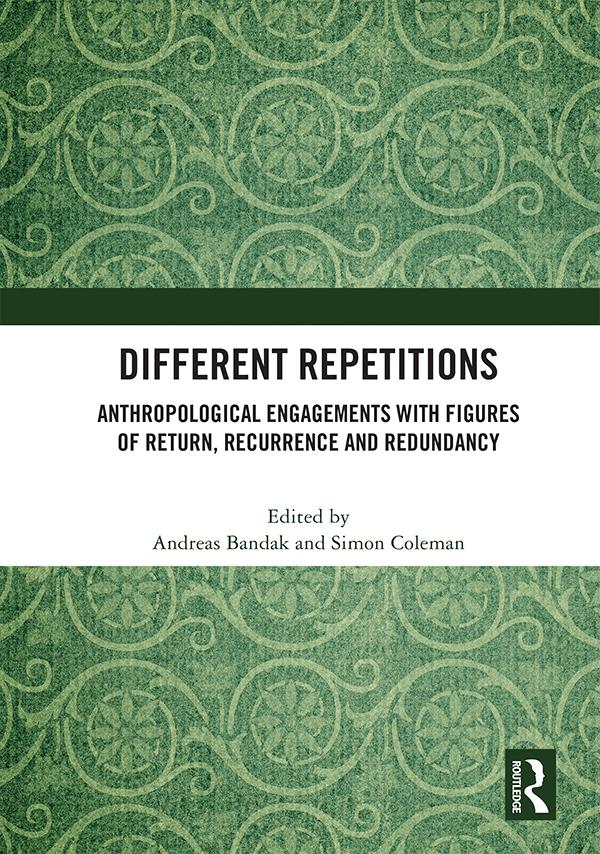
This book takes the concept of repetition beyond older anthropological debates over habit, structure, or cultural continuity and demonstrates its value in attempts to comprehend the temporal, spatial and ideological fields in which contemporary social scientists must operate.
Repetition has an ambiguous value in human societies. It may contribute to desired social and cultural reproduction or, equally, represent experiences of being trapped in cycles of routine and stasis. In this book, six anthropologists demonstrate the capacity of repetition to open up fertile areas of comparative ethnographic and historical work. Focusing on religious case-studies drawn from around the world, contributors ask when and how repetition is observed by interlocutors or fieldworkers. In the process, they explore the ethical, political and experiential dimensions of repetition as it operates at numerous scales of activity, ranging from intimate ritual, to forms of religious dissent, to haunting forms of historical recurrence.
The chapters in this book were originally published as a special issue of History and Anthropology.
Pay easily by card, Klarna, Apple Pay or Google Pay. Not happy? You always have a 14-day money-back guarantee. Read more in our terms. If you have any questions, email us at hello@memmo.org.
Memmo makes studying easier – wherever you are in the world. We bring your course books and smart study tools together in one place: summaries, quizzes, podcasts and flashcards. Plus Ted, your study buddy who answers anything you wonder. Over 50,000 students already study here – built to help you learn faster and stress less.