
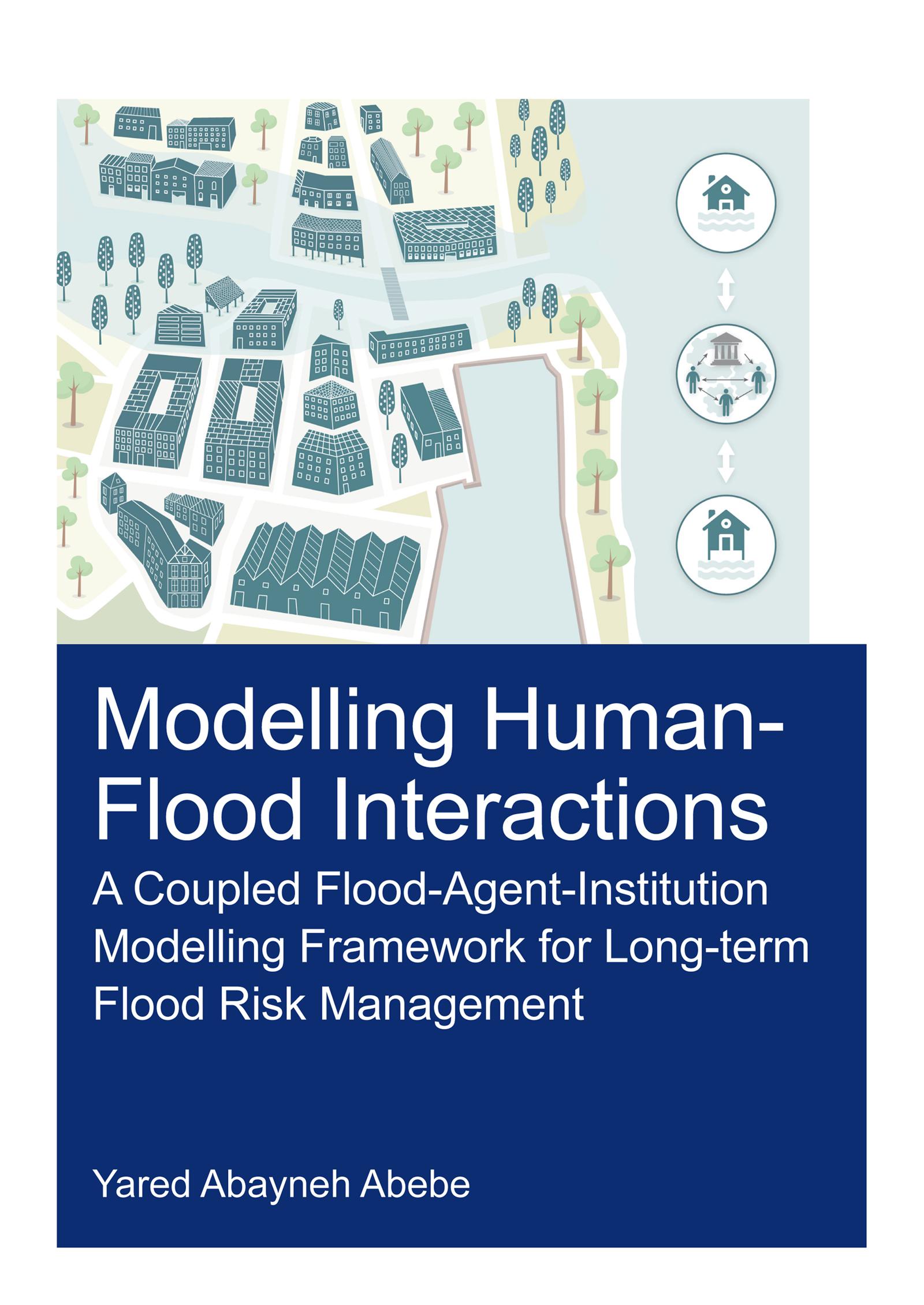
The negative impacts of floods are attributed to the extent and magnitude of a flood hazard, and the vulnerability and exposure of natural and human elements. In flood risk management (FRM) studies, it is crucial to model the interaction between human and flood subsystems across multiple spatial, temporal and organizational scales. Models should address the heterogeneity that exists within the human subsystem, and incorporate institutions that shape the behaviour of individuals. Hence, the main objectives of the dissertation are to develop a modelling framework and a methodology to build holistic models for FRM, and to assess how coupled human-flood interaction models support FRM policy analysis and decision-making. To achieve the objectives, the study introduces the Coupled fLood-Agent-Institution Modelling framework (CLAIM). CLAIM integrates actors, institutions, the urban environment, hydrologic and hydrodynamic processes and external factors, which affect FRM activities. The framework draws on the complex system perspective and conceptualizes the interaction of floods, humans and their environment as drivers of flood hazard, vulnerability and exposure. The human and flood subsystems are modelled using agent-based models and hydrodynamic models, respectively. The two models are dynamically coupled to understand human-flood interactions and to investigate the effect of institutions on FRM policy analysis.
Pay easily by card, Klarna, Apple Pay or Google Pay. Not happy? You always have a 14-day money-back guarantee. Read more in our terms. If you have any questions, email us at hello@memmo.org.
Memmo makes studying easier – wherever you are in the world. We bring your course books and smart study tools together in one place: summaries, quizzes, podcasts and flashcards. Plus Ted, your study buddy who answers anything you wonder. Over 50,000 students already study here – built to help you learn faster and stress less.