
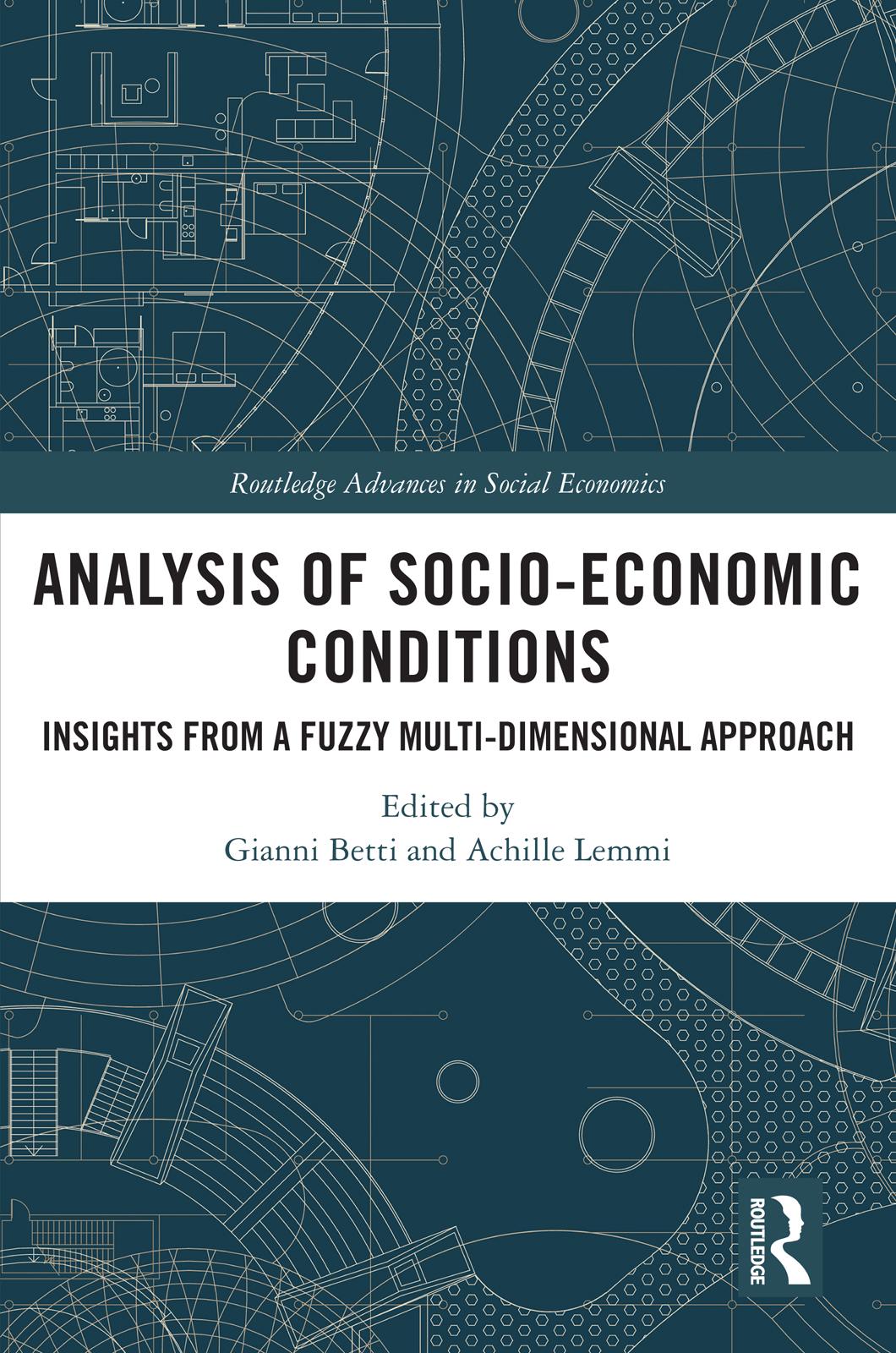
Showcasing fuzzy set theory, this book highlights the enormous potential of fuzzy logic in helping to analyse the complexity of a wide range of socio-economic patterns and behaviour.
The contributions to this volume explore the most up-to-date fuzzy-set methods for the measurement of socio-economic phenomena in a multidimensional and/or dynamic perspective. Thus far, fuzzy-set theory has primarily been utilised in the social sciences in the field of poverty measurement. These chapters examine the latest work in this area, while also exploring further applications including social exclusion, the labour market, educational mismatch, sustainability, quality of life and violence against women. The authors demonstrate that real-world situations are often characterised by imprecision, uncertainty and vagueness, which cannot be properly described by the classical set theory which uses a simple true–false binary logic. By contrast, fuzzy-set theory has been shown to be a powerful tool for describing the multidimensionality and complexity of social phenomena.
This book will be of significant interest to economists, statisticians and sociologists utilising quantitative methods to explore socio-economic phenomena.
Pay easily by card, Klarna, Apple Pay or Google Pay. Not happy? You always have a 14-day money-back guarantee. Read more in our terms. If you have any questions, email us at hello@memmo.org.
Memmo makes studying easier – wherever you are in the world. We bring your course books and smart study tools together in one place: summaries, quizzes, podcasts and flashcards. Plus Ted, your study buddy who answers anything you wonder. Over 50,000 students already study here – built to help you learn faster and stress less.