
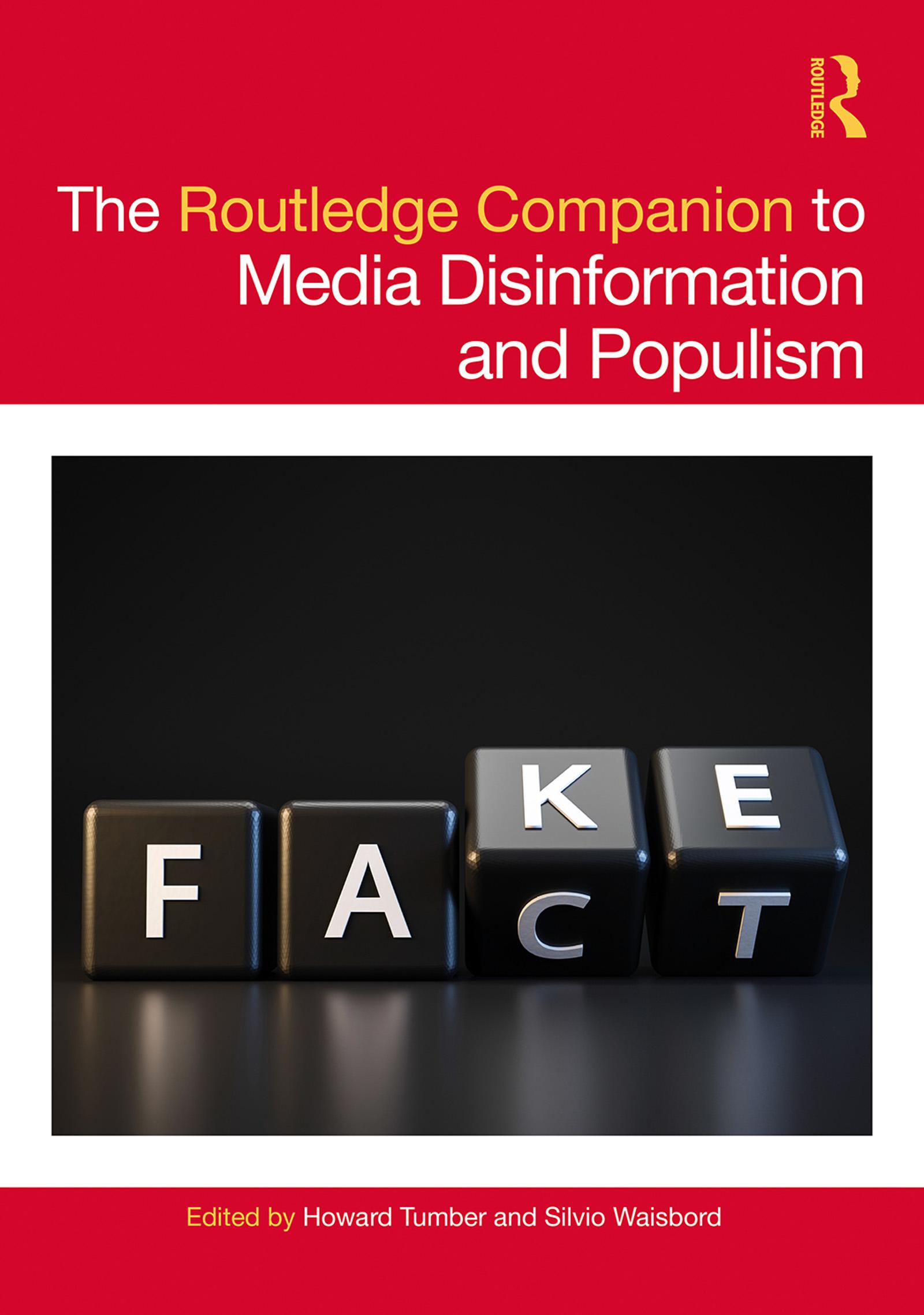
This companion brings together a diverse set of concepts used to analyse dimensions of media disinformation and populism globally.
The Routledge Companion to Media Disinformation and Populism explores how recent transformations in the architecture of public communication and particular attributes of the digital media ecology are conducive to the kind of polarised, anti-rational, post-fact, post-truth communication championed by populism. It is both interdisciplinary and multidisciplinary, consisting of contributions from both leading and emerging scholars analysing aspects of misinformation, disinformation, and populism across countries, political systems, and media systems. A global, comparative approach to the study of misinformation and populism is important in identifying common elements and characteristics, and these individual chapters cover a wide range of topics and themes, including fake news, mediatisation, propaganda, alternative media, immigration, science, and law-making, to name a few.
This companion is a key resource for academics, researchers, and policymakers as well as undergraduate and postgraduate students in the fields of political communication, journalism, law, sociology, cultural studies, international politics and international relations.
Pay easily by card, Klarna, Apple Pay or Google Pay. Not happy? You always have a 14-day money-back guarantee. Read more in our terms. If you have any questions, email us at hello@memmo.org.
Memmo makes studying easier – wherever you are in the world. We bring your course books and smart study tools together in one place: summaries, quizzes, podcasts and flashcards. Plus Ted, your study buddy who answers anything you wonder. Over 75,000 students already study here – built to help you learn faster and stress less.