
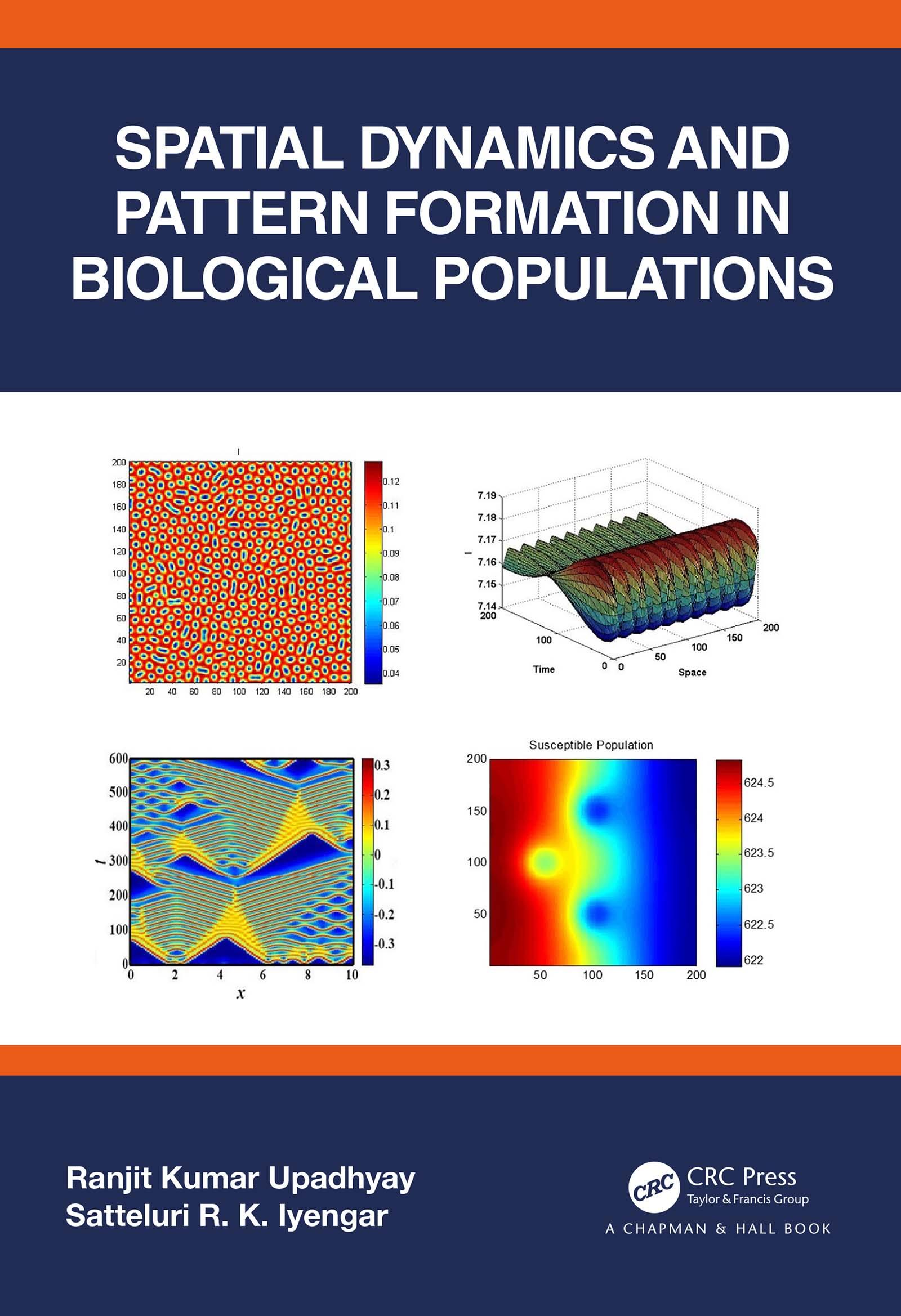
The book provides an introduction to deterministic (and some stochastic) modeling of spatiotemporal phenomena in ecology, epidemiology, and neural systems. A survey of the classical models in the fields with up to date applications is given.
The book begins with detailed description of how spatial dynamics/diffusive processes influence the dynamics of biological populations. These processes play a key role in understanding the outbreak and spread of pandemics which help us in designing the control strategies from the public health perspective. A brief discussion on the functional mechanism of the brain (single neuron models and network level) with classical models of neuronal dynamics in space and time is given. Relevant phenomena and existing modeling approaches in ecology, epidemiology and neuroscience are introduced, which provide examples of pattern formation in these models. The analysis of patterns enables us to study the dynamics of macroscopic and microscopic behaviour of underlying systems and travelling wave type patterns observed in dispersive systems. Moving on to virus dynamics, authors present a detailed analysis of different types models of infectious diseases including two models for influenza, five models for Ebola virus and seven models for Zika virus with diffusion and time delay. A Chapter is devoted for the study of Brain Dynamics (Neural systems in space and time).
Significant advances made in modeling the reaction-diffusion systems are presented and spatiotemporal patterning in the systems is reviewed. Development of appropriate mathematical models and detailed analysis (such as linear stability, weakly nonlinear analysis, bifurcation analysis, control theory, numerical simulation) are presented.
Key Features
- Covers the fundamental concepts and mathematical skills required to analyse reaction-diffusion models for biological populations.
- Concepts are introduced in such a way that readers with a basic knowledge of differential equations and numerical methods can understand the analysis. The results are also illustrated with figures.
- Focuses on mathematical modeling and numerical simulations using basic conceptual and classic models of population dynamics, Virus and Brain dynamics.
- Covers wide range of models using spatial and non-spatial approaches.
- Covers single, two and multispecies reaction-diffusion models from ecology and models from bio-chemistry. Models are analysed for stability of equilibrium points, Turing instability, Hopf bifurcation and pattern formations.
- Uses Mathematica for problem solving and MATLAB for pattern formations.
- Contains solved Examples and Problems in Exercises.
The Book is suitable for advanced undergraduate, graduate and research students. For those who are working in the above areas, it provides information from most of the recent works. The text presents all the fundamental concepts and mathematical skills needed to build models and perform analyses.
Pay easily by card, Klarna, Apple Pay or Google Pay. Not happy? You always have a 14-day money-back guarantee. Read more in our terms. If you have any questions, email us at hello@memmo.org.
Memmo makes studying easier – wherever you are in the world. We bring your course books and smart study tools together in one place: summaries, quizzes, podcasts and flashcards. Plus Ted, your study buddy who answers anything you wonder. Over 75,000 students already study here – built to help you learn faster and stress less.