
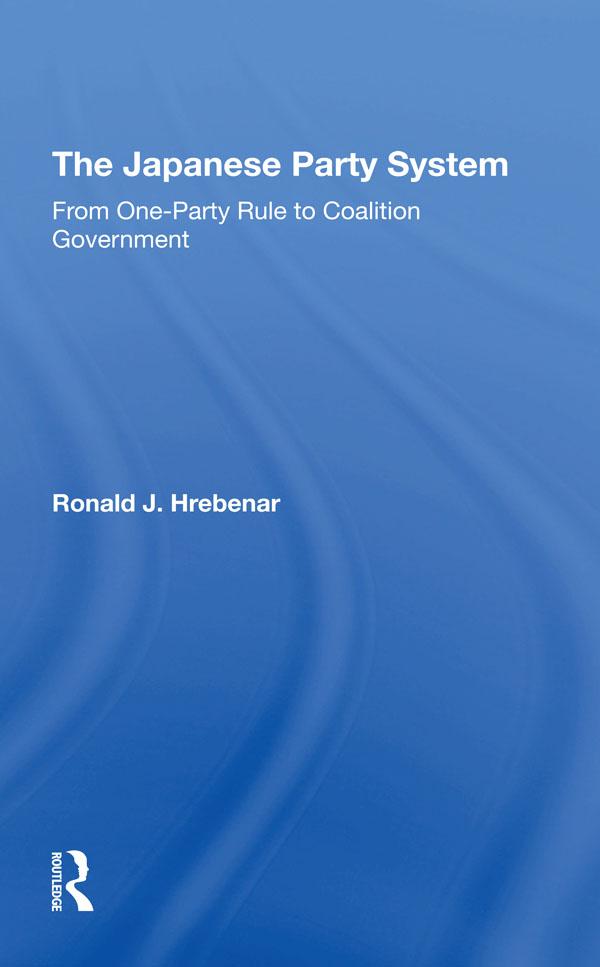
“This is a nuts and bolts textbook in the best sense of the term. … It is bound to be a great boon both to teachers and students of contemporary Japanese politics.” —from the Foreword by Haruhiro Fukui This timely volume is the first book in nearly twenty-five years to focus on the party system of Japan. In the past two decades, the Japanese political scene has undergone a dramatic transformation. What had been a two-party system proliferated during the 1960s and 1970s into a seven-party system. This book provides a comprehensive look at all of Japan’s current major and minor national-level parties. For the first time in English, detailed analyses are presented on the Democratic Socialists, the Clean Government party (KÅmeitÅ), and the New Liberal Club. Thorough coverage is provided for parties in the “1955 System”—the ruling Liberal Democratic party and the two long-term opposition parties, the Socialists and the Communists. Many of the new miniparties that have appeared in recent elections are also discussed. Japanese Political Parties gives readers a solid understanding of party histories, leadership, and internal organization, as well as a look at prospects for the future. The party discussions are preceded by three chapters on the laws and political forces affecting Japanese politics. Chapter 1 describes the basic characteristics of the Japanese party system since 1945 and provides an overview of Japanese voting behavior and political values. Chapter 2 describes the “rules of the game”—the electoral laws—and discusses the ongoing political problem of malapportionment. Chapter 3 interprets data on political finance in contemporary Japan. Along with a wealth of information and interpretation, the authors offer insight into the common patterns Japan shares with democracies around the world, placing the Japanese system within the larger context of world party systems. Designed for courses on Japanese politics, this text should also prove useful to students of comparative politics and political parties.
Pay easily by card, Klarna, Apple Pay or Google Pay. Not happy? You always have a 14-day money-back guarantee. Read more in our terms. If you have any questions, email us at hello@memmo.org.
Memmo makes studying easier – wherever you are in the world. We bring your course books and smart study tools together in one place: summaries, quizzes, podcasts and flashcards. Plus Ted, your study buddy who answers anything you wonder. Over 50,000 students already study here – built to help you learn faster and stress less.