
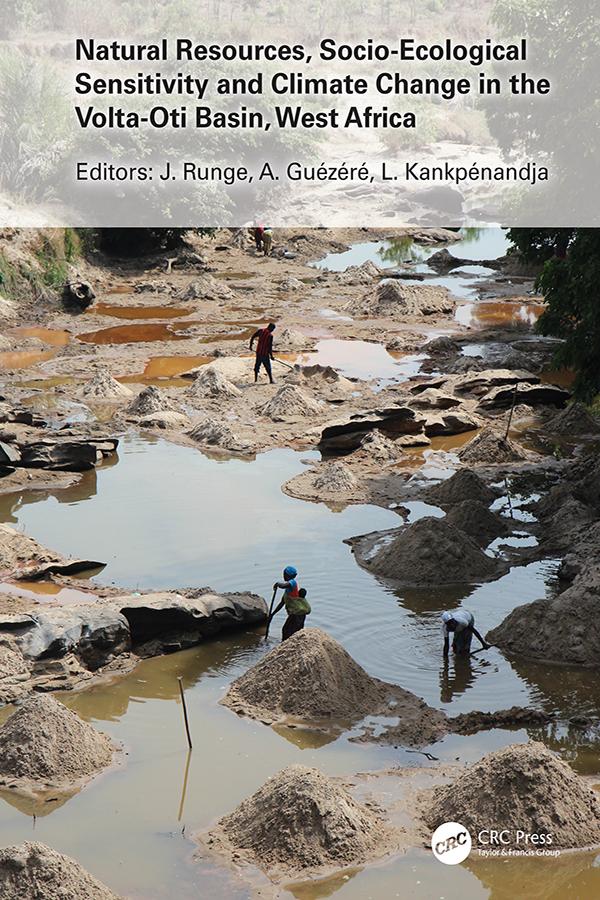
This book presents the outcome of an interdisciplinary and international workshop supported by the Volkswagen Stiftung (funding line ‘Knowledge for Tomorrow’) on the topic of ‘Natural Resources, Socio-Ecological Sensitivity and Climate Change in the Volta-Oti Basin, West Africa’. The conference was jointly organised by Goethe-University Frankfurt (Germany) and the University of Kara (Togo) held from March 6 to 8, 2019 in northern Togo. It aimed to strengthen capacities of junior scientists from the sub-region, exchange and mobilise theoretical and methodological background from various scientific fields (Botany, Construction, Geology, Geography, Infrastructure, Politics, Remote Sensing, Sociology and Urban Planning). One goal was to deliver reliable elements for ongoing and profound environmental analyses that lie outside the common questions of the academic and civil society stakeholders.
Ecosystem fragmentation and deforestation in West Africa are mainly triggered by humans such as agriculture and small-scale forest disturbances for charcoal and firewood production. Increasing population pressure, declining of carrying capacity and demand for agricultural land caused the reduction of land conservation capacities, even in protected areas. The complexity of interactions between environmental and socio-ecological systems and subsequent effects (sensitivity) has raised ongoing international awareness in light of ongoing climate change. By the example of natural resources, land use and stakeholders’ perceptions within the Volta-Oti Basin the book’s proceedings present, discuss and distribute new findings that will sustainably stimulate the international debate. The workshop also intended to overcome national borders and language barriers between the Anglophone (Ghana) and the Francophone (Benin, Burkina Faso, Ivory Coast, Togo) research communities, and supported better West African cooperation and networking. The young as well as the established partners formed new collaborations, and the event at the University of Kara (Togo) was a truly unique opportunity for all involved, not only to discuss science, but also to assess applied and best future management practices for the Oti-Volta Basin in West Africa.
Pay easily by card, Klarna, Apple Pay or Google Pay. Not happy? You always have a 14-day money-back guarantee. Read more in our terms. If you have any questions, email us at hello@memmo.org.
Memmo makes studying easier – wherever you are in the world. We bring your course books and smart study tools together in one place: summaries, quizzes, podcasts and flashcards. Plus Ted, your study buddy who answers anything you wonder. Over 50,000 students already study here – built to help you learn faster and stress less.