
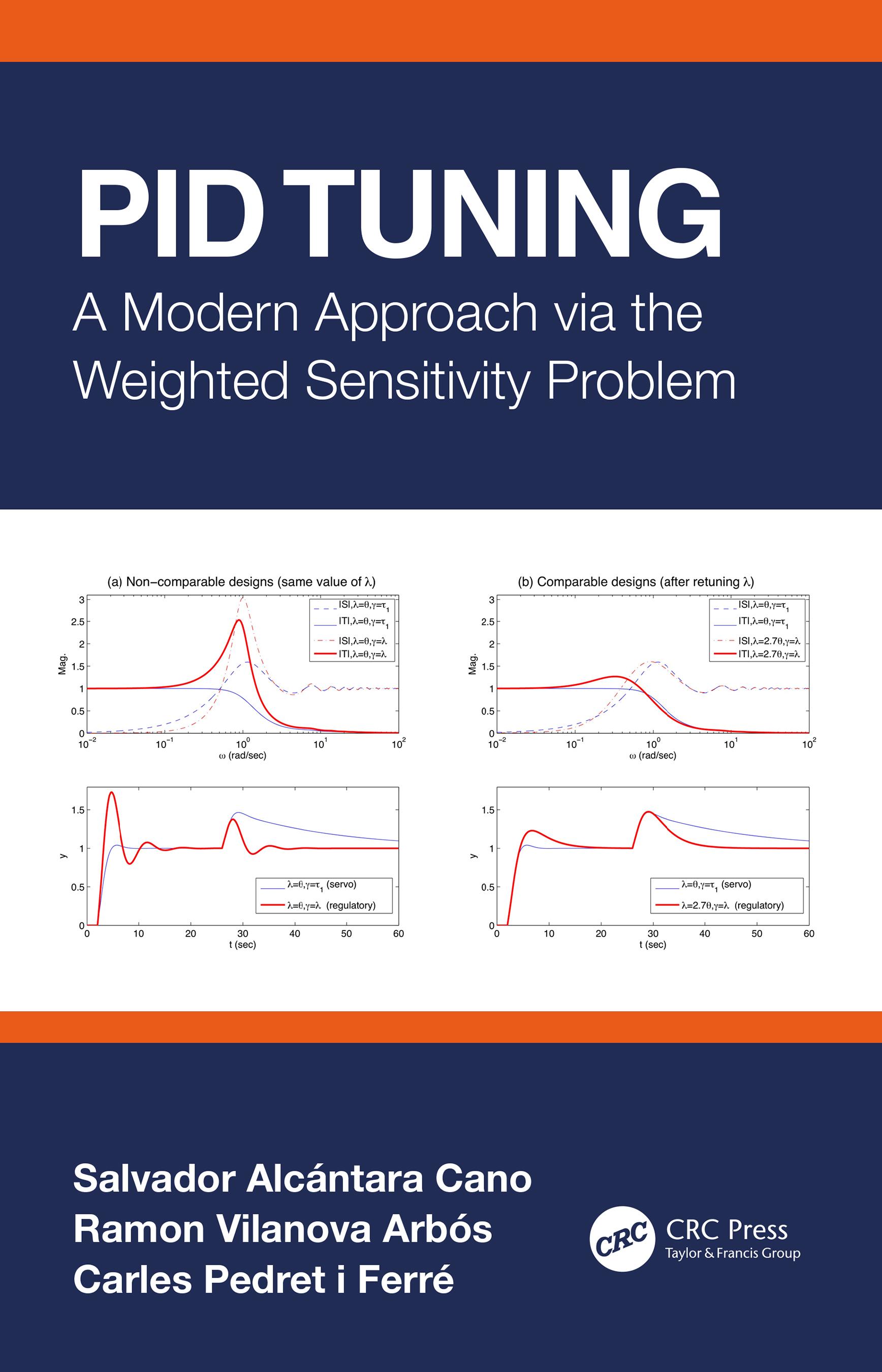
The PID controller is the most common option in the realm of control applications and is dominant in the process control industry. Among the related analytical methods, Internal Model Control (IMC) has gained remarkable industrial acceptance due to its robust nature and good set-point responses. However, the traditional application of IMC results in poor load disturbance rejection for lag-dominant and integrating plants. This book presents an IMC-like design method which avoids this common pitfall and is devised to work well for plants of modest complexity, for which analytical PID tuning is plausible. For simplicity, the design only focuses on the closed-loop sensitivity function, including formulations for the H∞ and H2 norms. Aimed at graduate students and researchers in control engineering, this book:
- Considers both the robustness/performance and the servo/regulation trade-offs
- Presents a systematic, optimization-based approach, ultimately leading to well-motivated, model-based, and analytically derived tuning rules
- Shows how to tune PID controllers in a unified way, encompassing stable, integrating, and unstable processes
- Finds in the Weighted Sensitivity Problem the sweet spot of robust, optimal, and PID control
- Provides a common analytical framework that generalizes existing tuning proposals
Pay easily by card, Klarna, Apple Pay or Google Pay. Not happy? You always have a 14-day money-back guarantee. Read more in our terms. If you have any questions, email us at hello@memmo.org.
Memmo makes studying easier – wherever you are in the world. We bring your course books and smart study tools together in one place: summaries, quizzes, podcasts and flashcards. Plus Ted, your study buddy who answers anything you wonder. Over 50,000 students already study here – built to help you learn faster and stress less.