
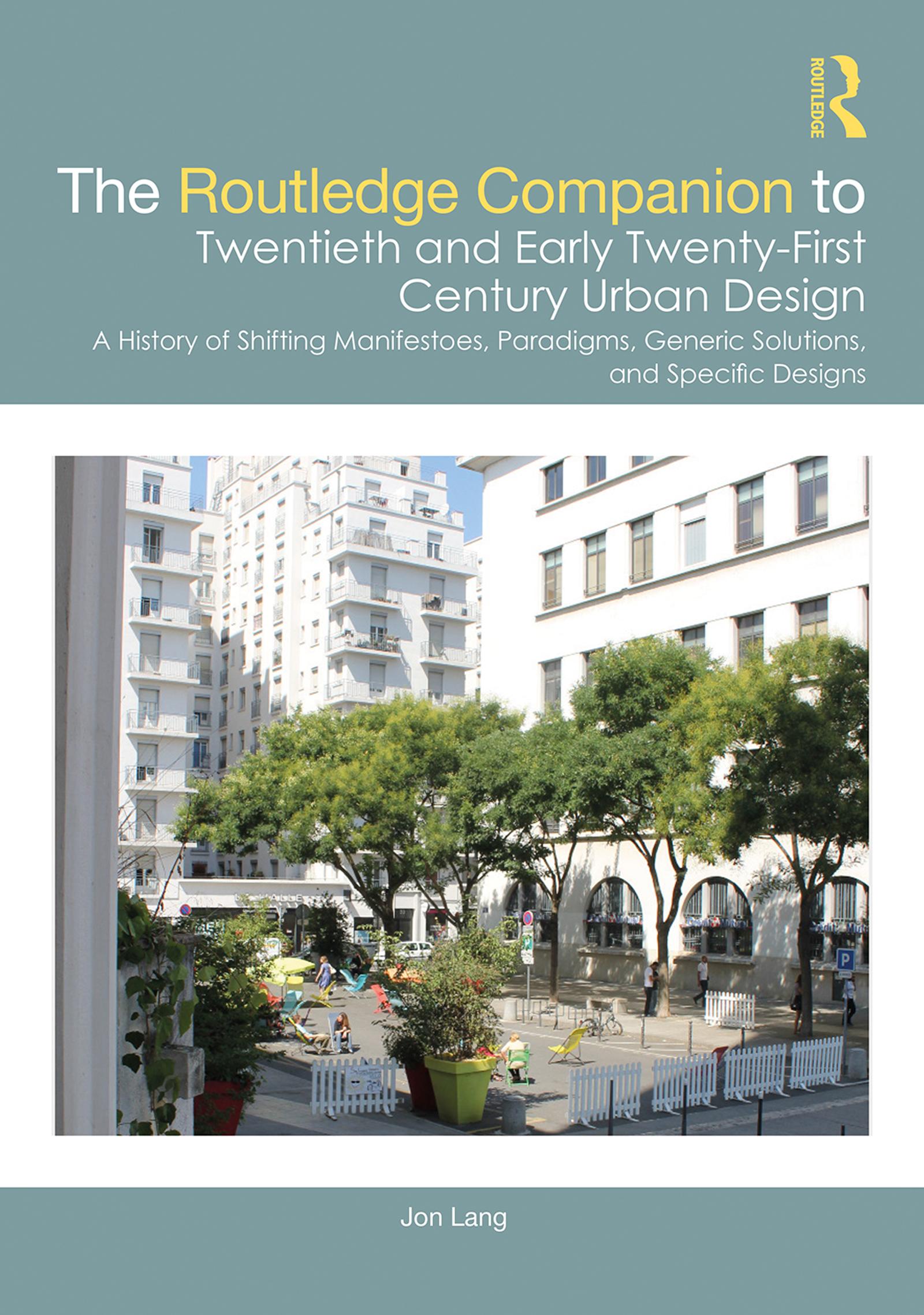
The Routledge Companion to Twentieth and Early Twenty-First Century Urban Design is a fully illustrated descriptive and explanatory history of the development of urban design ideas and paradigms of the past 150 years. The ideas and projects, hypothetical and built, range in scale from the city to the urban block level. The focus is on where the generic ideas originated, the projects that were designed following their precepts, the functions they address and/or afford, and what we can learn from them.
The morphology of a city—its built environment—evolves unselfconsciously as private and governmental investors self-consciously erect buildings and infrastructure in a pragmatic, piecemeal manner to meet their own ends. Philosophers, novelists, architects, and social scientists have produced myriad ideas about the nature of the built environment that they consider to be superior to those forms resulting from a laissez-faire attitude to urban development.
Rationalist theorists dream of ideal futures based on assumptions about what is good; empiricists draw inspirations from what they perceive to be working well in existing situations. Both groups have presented their advocacies in manifestoes and often in the form of generic solutions or illustrative designs. This book traces the history of these ideas and will become a standard reference for scholars and students interested in the history of urban spaces, including architects, planners, urban historians, urban geographers, and urban morphologists.
Pay easily by card, Klarna, Apple Pay or Google Pay. Not happy? You always have a 14-day money-back guarantee. Read more in our terms. If you have any questions, email us at hello@memmo.org.
Memmo makes studying easier – wherever you are in the world. We bring your course books and smart study tools together in one place: summaries, quizzes, podcasts and flashcards. Plus Ted, your study buddy who answers anything you wonder. Over 50,000 students already study here – built to help you learn faster and stress less.