
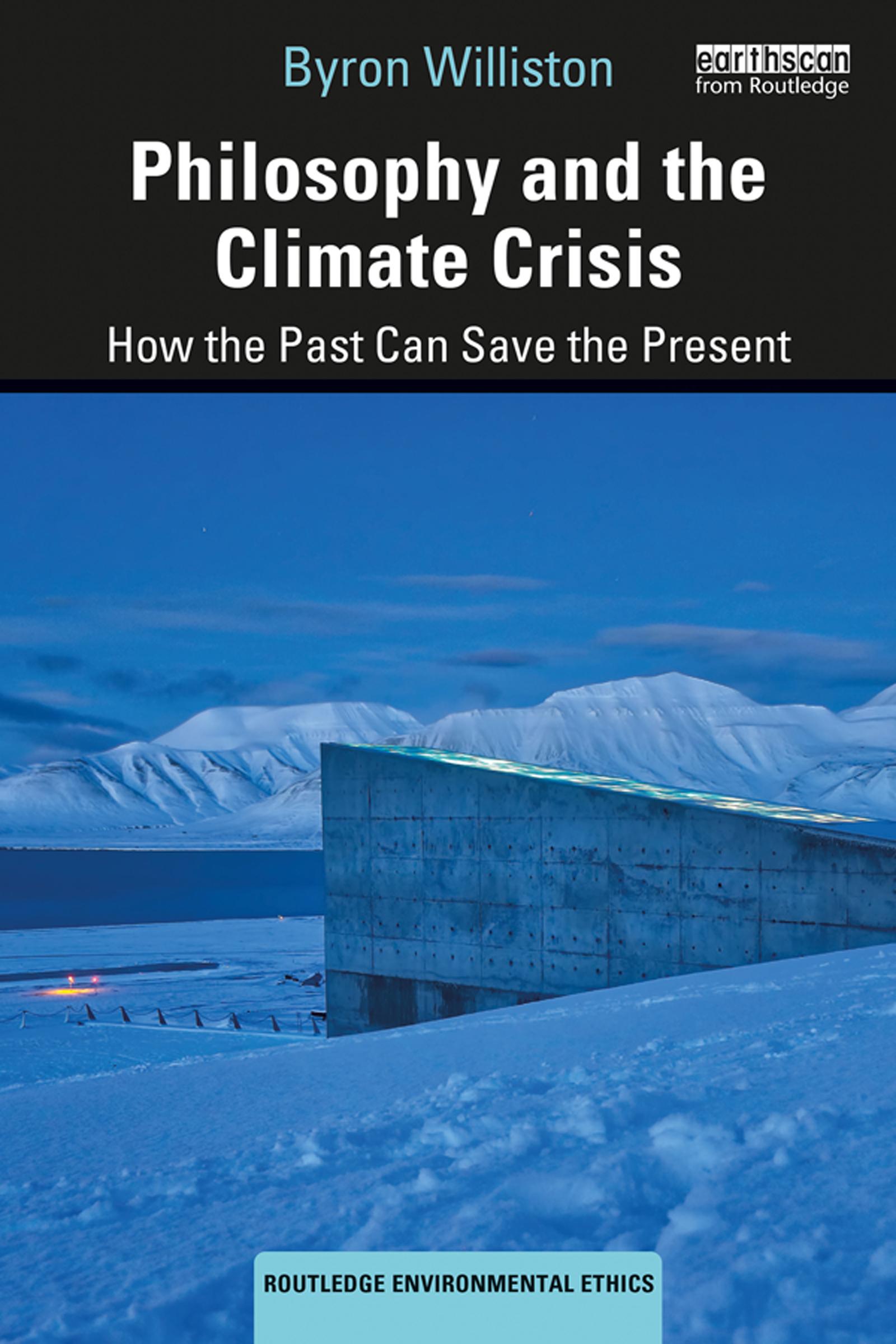
This book explores how the history of philosophy can orient us to the new reality brought on by the climate crisis.
If we understand the climate crisis as a deeply existential one, it can help to examine the way past philosophers responded to similar crises in their times. This book explores five past crises, each involving a unique form of collective trauma. These events—war, occupation, exile, scientific revolution and political revolution—inspired the philosophers to remake the whole world in thought, to construct a metaphysics. Williston distills a key intellectual innovation from each metaphysical system:
• That political power must be constrained by knowledge of the climate system (Plato)
• That ethical and political reasoning must be informed by care or love of the ecological whole (Augustine)
• That we must enhance the design of the technosphere (Descartes)
• That we must conceive the Earth as an internally complex system (Spinoza)
• And that we must grant rights to anyone or anything—ultimately the Earth system itself—whose vital interests are threatened by the effects of climate change (Hegel).
Philosophy and the Climate Crisis will be of great interest to students and scholars of climate change, environmental philosophy and ethics and the environmental humanities.
Pay easily by card, Klarna, Apple Pay or Google Pay. Not happy? You always have a 14-day money-back guarantee. Read more in our terms. If you have any questions, email us at hello@memmo.org.
Memmo makes studying easier – wherever you are in the world. We bring your course books and smart study tools together in one place: summaries, quizzes, podcasts and flashcards. Plus Ted, your study buddy who answers anything you wonder. Over 50,000 students already study here – built to help you learn faster and stress less.