
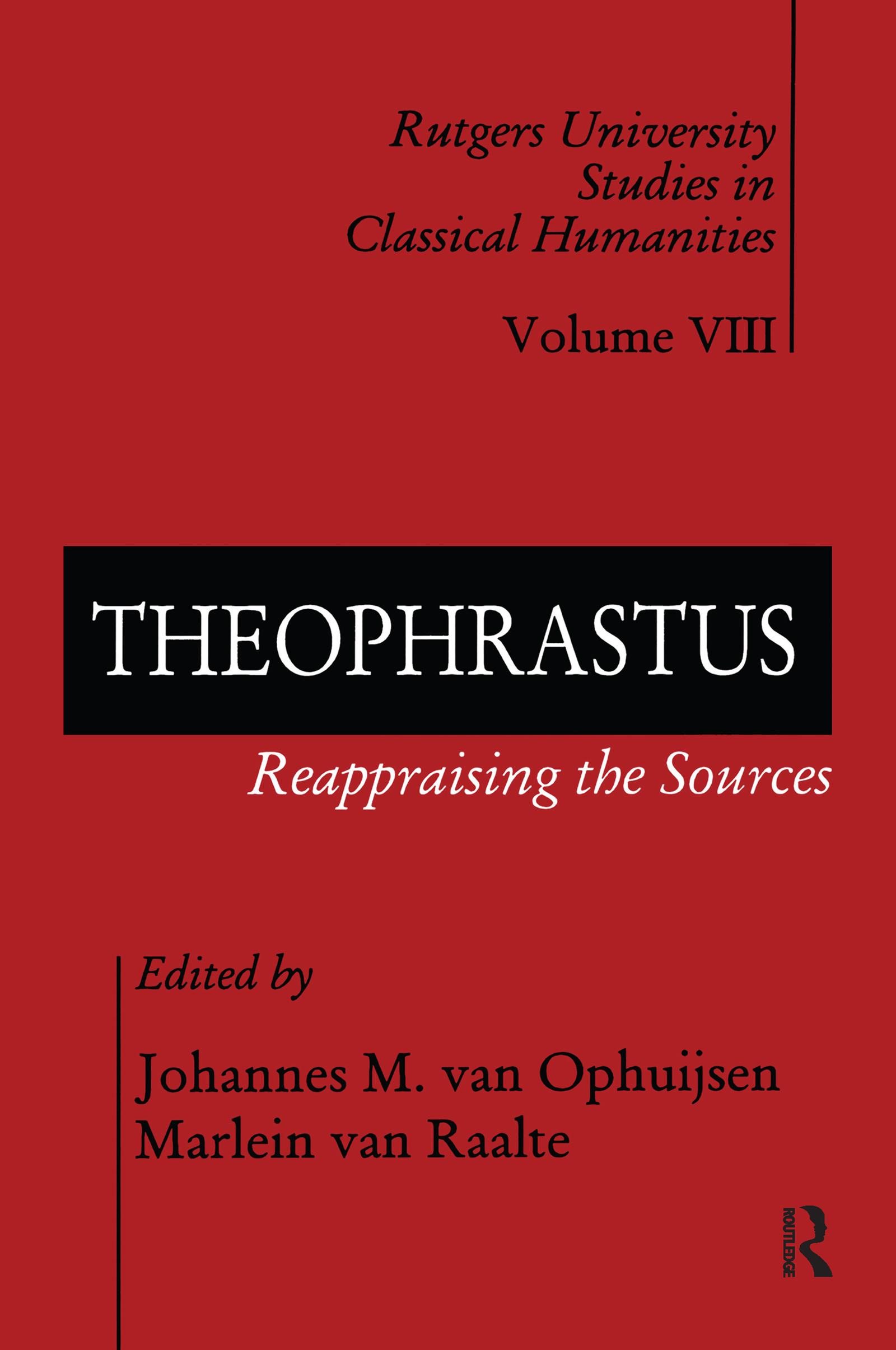
Theophrastus was Aristotle's pupil and second head of the Peripatetic School. Apart from two botanical works, a collection of character sketches, and several scientific opuscula, his works survive only through quotations and reports in secondary sources. Recently these quotations and reports have been collected and published, thereby making the thought of Theophrastus accessible to a wide audience. The present volume contains seventeen responses to this material.
There are chapters dealing with Theophrastus' views on logic, physics, biology, ethics, politics, rhetoric, and music, as well as the life of Theophrastus. Together these writings throw considerable light on fundamental questions concerning the development and importance of the Peripatos in the early Hellenistic period. The authors consider whether Theophrastus was a systematic thinker who imposed coherence and consistency on a growing body of knowledge, or a problem-oriented thinker who foreshadowed the dissolution of Peripatetic thought into various loosely connected disciplines. Of special interest are those essays which deal with Theophrastus' intellectual position in relation to the lively philosophic scene occupied by such contemporaries as Zeno, the founder of the Stoa, and Epicurus, the founder of the Garden, as well as Xenocrates and Polemon hi the Academy, and Theophrastus' fellow Peripatetics, Eudemus and Strato.
The contributors to the volume are Suzanne Amigues, Antonio Battegazzore, Tiziano Dorandi, Woldemar Gorier, John Glucker, Hans Gottschalk, Frans de Haas, Andre Laks, Anthony Long, Jorgen Mejer, Mario Mignucci, Trevor Saunders, Dirk Schenkeveld, David Sedley, Robert Sharpies, C. M. J. Sicking and Richard Sorabji. The Rutgers University Studies in Classical Humanities series is a forum for seminal thinking in the field of philosophy, and this volume is no exception. Theophrastus is a landmark achievement in intellectual thought. Philosophers, historians, and classicists will all find this work to be enlightening.
Pay easily by card, Klarna, Apple Pay or Google Pay. Not happy? You always have a 14-day money-back guarantee. Read more in our terms. If you have any questions, email us at hello@memmo.org.
Memmo makes studying easier – wherever you are in the world. We bring your course books and smart study tools together in one place: summaries, quizzes, podcasts and flashcards. Plus Ted, your study buddy who answers anything you wonder. Over 50,000 students already study here – built to help you learn faster and stress less.