
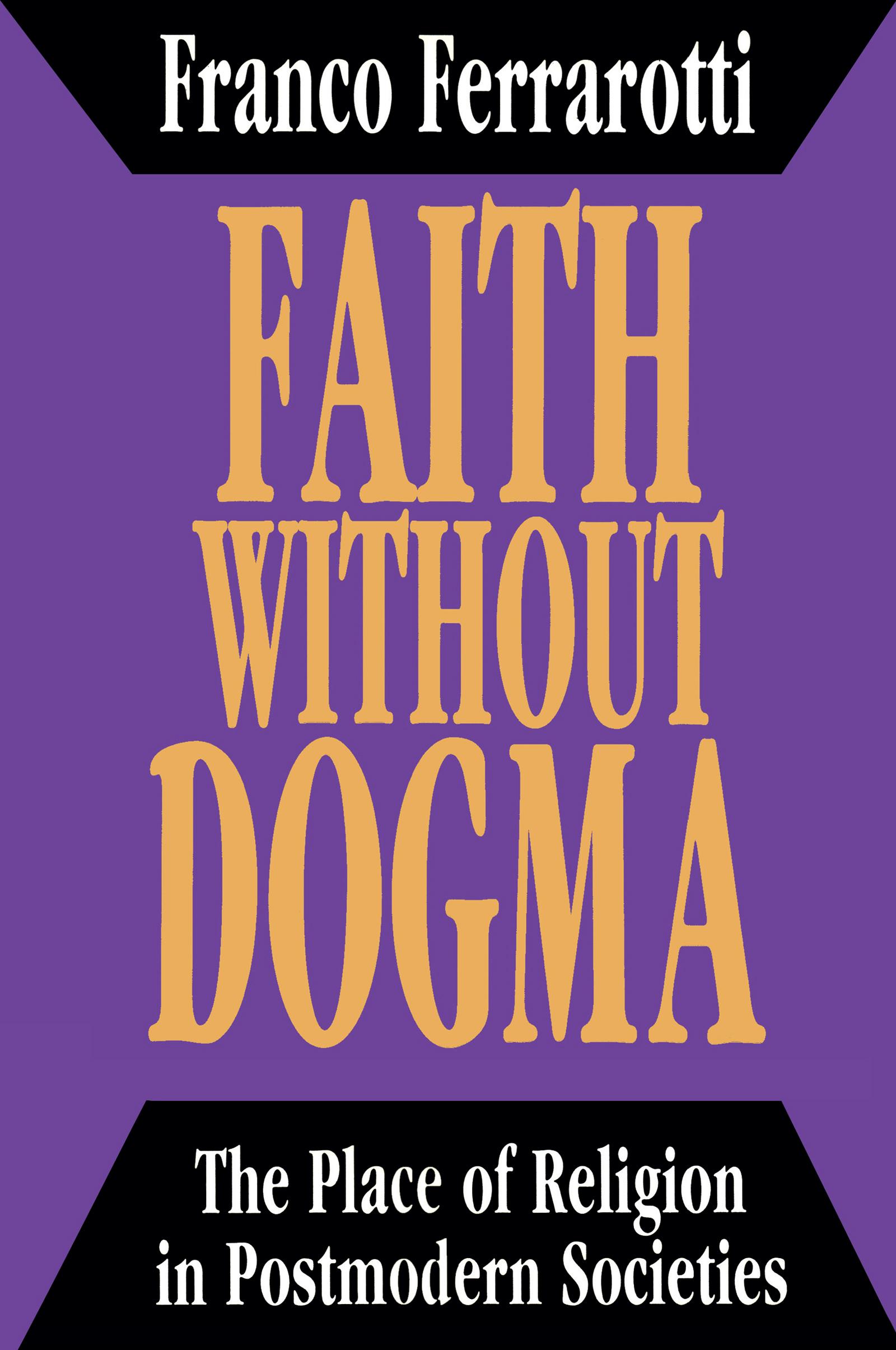
We live in a time of high Church membership, but low Church attendance. Franco Ferrarotti, arguably the most important sociologist of religion alive, captures the source of this paradox In the title of his new book, Faith without Dogma. For it is belief that propels membership, while the absence of dogma results in a reticence to accept hierarchical direction from above or beyond.
Basing much of his analysis on the postwar struggles within Roman Catholicism, Ferrarotti views the demand for religious renewal and revival as part and parcel of the emergence of broad social agendas—agendas to which not even the Roman curia could remain impervious. The former easy relationships between Church and State, especially authoritarian states in Europe and Latin America, gave way to a critical defense of individual rights within a context of a broadened vision of Christian doctrine.
In addition to issues Involved in internal affairs of religion, Ferrarotti explores a series of developments that have changed for all time the nature of Church survival. The critical element, one that goes beyond specific doctrinal accommodations, is the new primary connection of Church to people rather than Church to State. This came about through the widespread acceptance of science and technology as frames of intellectual reference, the emergence of secularization as mediating religious claims and the creation from the Enlightenment to the Postmodern eras of "civil religions."
The volume concludes with a set of chapters on the nature of sacred events and objects, the emergence of new varieties of prayer, and concludes with a chapter on the relationship of ideology to theology prepared especially for the English language edition of Faith without Dogma. This is a book likely to attract a broad audience among religionists and culturologists, as well as social scientists.
Pay easily by card, Klarna, Apple Pay or Google Pay. Not happy? You always have a 14-day money-back guarantee. Read more in our terms. If you have any questions, email us at hello@memmo.org.
Memmo makes studying easier – wherever you are in the world. We bring your course books and smart study tools together in one place: summaries, quizzes, podcasts and flashcards. Plus Ted, your study buddy who answers anything you wonder. Over 50,000 students already study here – built to help you learn faster and stress less.