
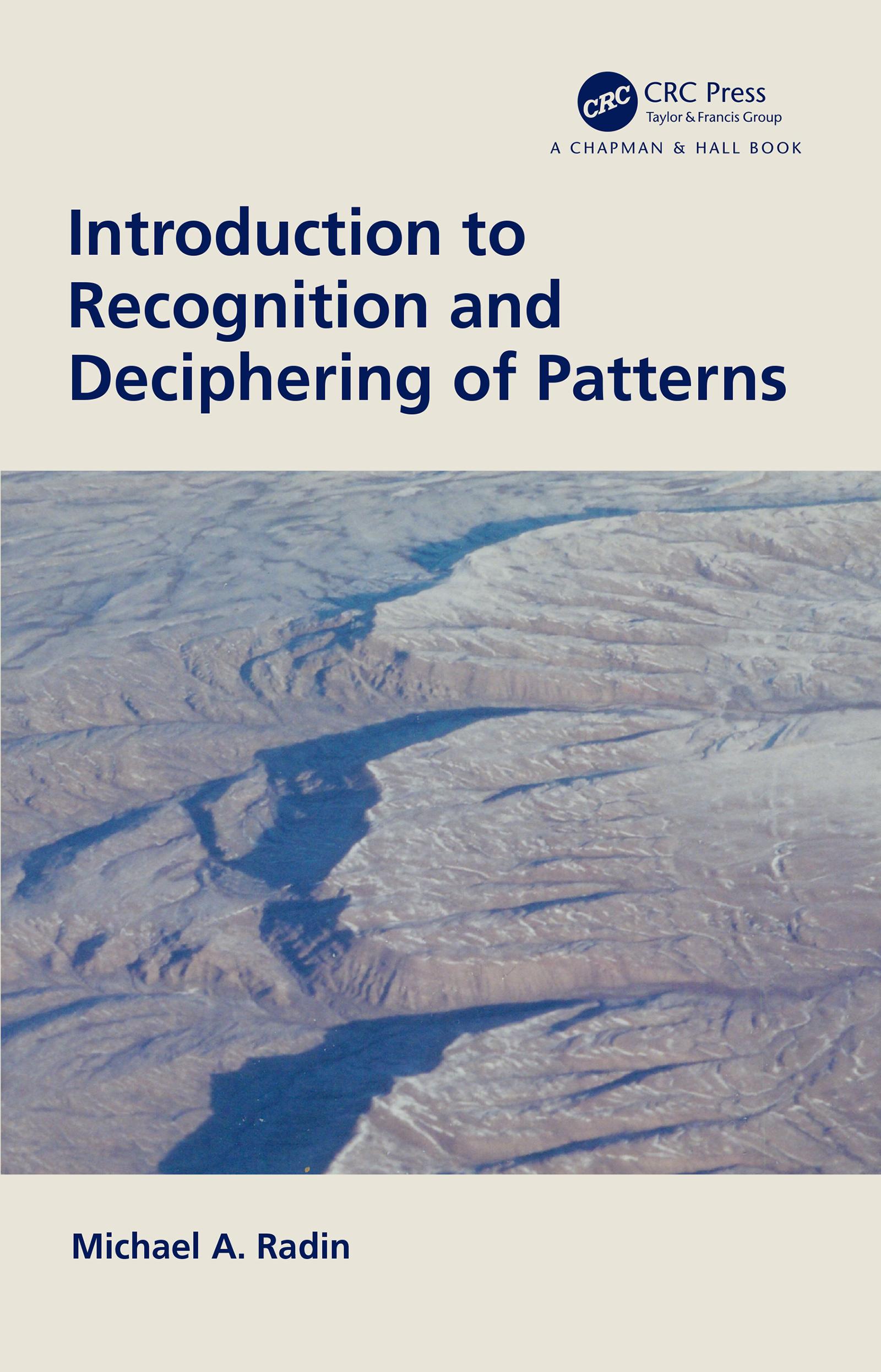
Introduction to Recognition and Deciphering of Patterns is meant to acquaint STEM and non-STEM students with different patterns, as well as to where and when specific patterns arise. In addition, the book teaches students how to recognize patterns and distinguish the similarities and differences between them.
Patterns, such as weather patterns, traffic patterns, behavioral patterns, geometric patterns, linguistic patterns, structural patterns, digital patterns, and the like, emerge on an everyday basis, . Recognizing patterns and studying their unique traits are essential for the development and enhancement of our intuitive skills and for strengthening our analytical skills. Mathematicians often apply patterns to get acquainted with new concepts--a technique that can be applied across many disciplines.
Throughout this book we explore assorted patterns that emerge from various geometrical configurations of squares, circles, right triangles, and equilateral triangles that either repeat at the same scale or at different scales. The book also analytically examines linear patterns, geometric patterns, alternating patterns, piecewise patterns, summation-type patterns and factorial-type patterns. Deciphering the details of these distinct patterns leads to the proof by induction method, and the book will also render properties of Pascal’s triangle and provide supplemental practice in deciphering specific patterns and verifying them.
This book concludes with first-order recursive relations: describing sequences as recursive relations, obtaining the general solution by solving an initial value problem, and determining the periodic traits.
Features
• Readily accessible to a broad audience, including those with limited mathematical background
• Especially useful for students in non-STEM disciplines, such as psychology, sociology, economics and business, as well as for liberal arts disciplines and art students.
Pay easily by card, Klarna, Apple Pay or Google Pay. Not happy? You always have a 14-day money-back guarantee. Read more in our terms. If you have any questions, email us at hello@memmo.org.
Memmo makes studying easier – wherever you are in the world. We bring your course books and smart study tools together in one place: summaries, quizzes, podcasts and flashcards. Plus Ted, your study buddy who answers anything you wonder. Over 75,000 students already study here – built to help you learn faster and stress less.