
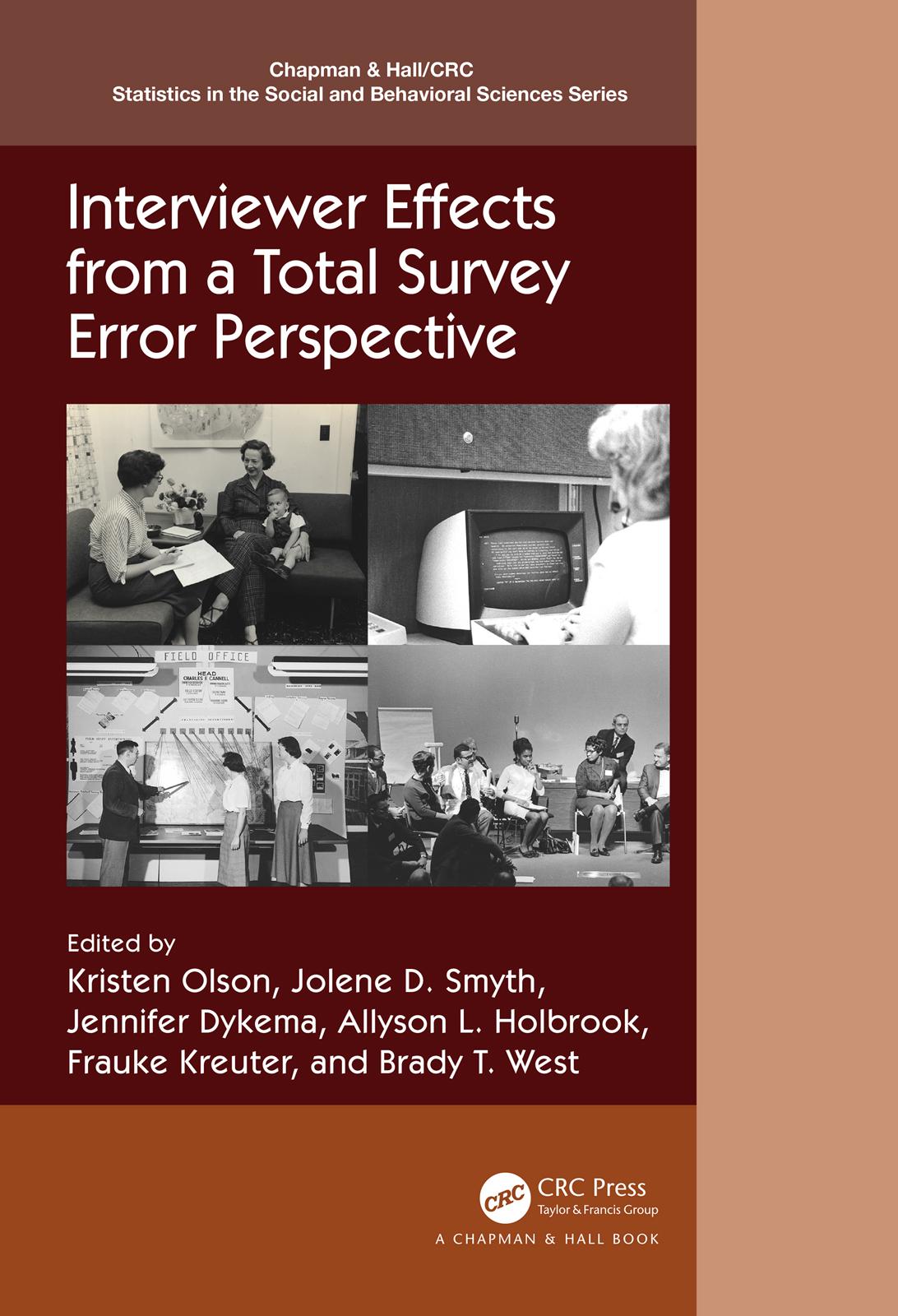
Interviewer Effects from a Total Survey Error Perspective presents a comprehensive collection of state-of-the-art research on interviewer-administered survey data collection. Interviewers play an essential role in the collection of the high-quality survey data used to learn about our society and improve the human condition. Although many surveys are conducted using self-administered modes, interviewer-administered modes continue to be optimal for surveys that require high levels of participation, include difficult-to-survey populations, and collect biophysical data. Survey interviewing is complex, multifaceted, and challenging. Interviewers are responsible for locating sampled units, contacting sampled individuals and convincing them to cooperate, asking questions on a variety of topics, collecting other kinds of data, and providing data about respondents and the interview environment. Careful attention to the methodology that underlies survey interviewing is essential for interviewer-administered data collections to succeed.
In 2019, survey methodologists, survey practitioners, and survey operations specialists participated in an international workshop at the University of Nebraska-Lincoln to identify best practices for surveys employing interviewers and outline an agenda for future methodological research. This book features 23 chapters on survey interviewing by these worldwide leaders in the theory and practice of survey interviewing. Chapters include:
- The legacy of Dr. Charles F. Cannell’s groundbreaking research on training survey interviewers and the theory of survey interviewing
- Best practices for training survey interviewers
- Interviewer management and monitoring during data collection
- The complex effects of interviewers on survey nonresponse
- Collecting survey measures and survey paradata in different modes
- Designing studies to estimate and evaluate interviewer effects
- Best practices for analyzing interviewer effects
- Key gaps in the research literature, including an agenda for future methodological research
- Chapter appendices available to download from https://digitalcommons.unl.edu/sociw/
Written for managers of survey interviewers, survey methodologists, and students interested in the survey data collection process, this unique reference uses the Total Survey Error framework to examine optimal approaches to survey interviewing, presenting state-of-the-art methodological research on all stages of the survey process involving interviewers. Acknowledging the important history of survey interviewing while looking to the future, this one-of-a-kind reference provides researchers and practitioners with a roadmap for maximizing data quality in interviewer-administered surveys.
Pay easily by card, Klarna, Apple Pay or Google Pay. Not happy? You always have a 14-day money-back guarantee. Read more in our terms. If you have any questions, email us at hello@memmo.org.
Memmo makes studying easier – wherever you are in the world. We bring your course books and smart study tools together in one place: summaries, quizzes, podcasts and flashcards. Plus Ted, your study buddy who answers anything you wonder. Over 50,000 students already study here – built to help you learn faster and stress less.