
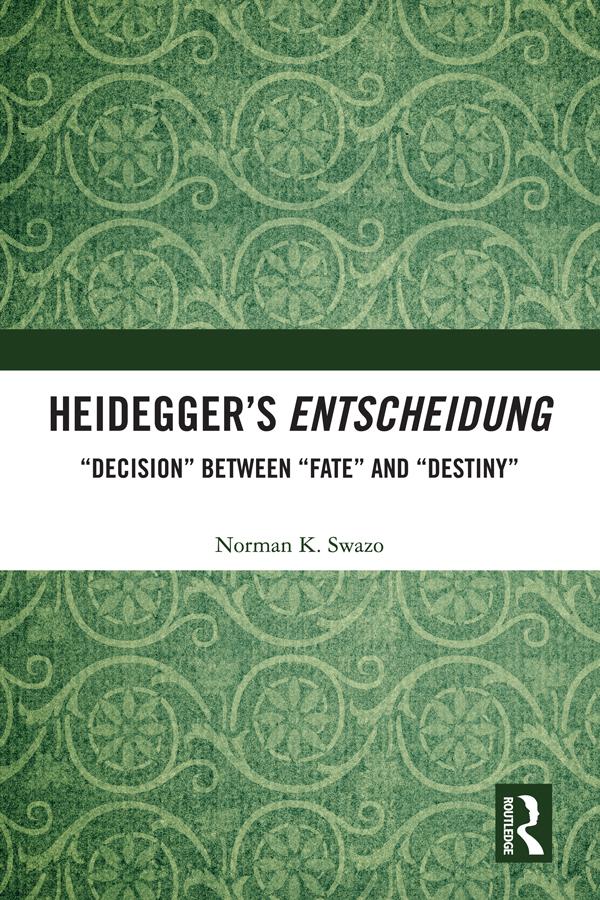
This book critically examines the debate on Martin Heidegger’s concept of Entscheidung ("decision") and his engagement and confrontation with Nazism in terms of his broader philosophical thought. It argues that one cannot explain Heidegger’s actions without accounting for his idea of "decision" and its connection to his understanding of individual "fate" and national (and European) "destiny." The book looks at the relation of biography to philosophy and the ethical and political implications of appropriating Heidegger’s thinking in these domains of inquiry. It highlights themes such as Heidegger’s differences with the neo-Kantians in Germany; Heidegger on Kant and practical reason; and his reading of Nietzsche and Hegel. It offers a philosophical assessment grounded in Heidegger’s own texts, with reference to historical and other philosophical commentaries on the rise of National Socialism in post-Weimar Germany and the philosophical issues associated with the interpretation of Nazi genocide and ideology.
An important intervention in Western philosophy, this book will be of great interest to scholars and researchers of political philosophy, continental philosophy, German philosophy, philosophy in general, and political studies.
Pay easily by card, Klarna, Apple Pay or Google Pay. Not happy? You always have a 14-day money-back guarantee. Read more in our terms. If you have any questions, email us at hello@memmo.org.
Memmo makes studying easier – wherever you are in the world. We bring your course books and smart study tools together in one place: summaries, quizzes, podcasts and flashcards. Plus Ted, your study buddy who answers anything you wonder. Over 50,000 students already study here – built to help you learn faster and stress less.