
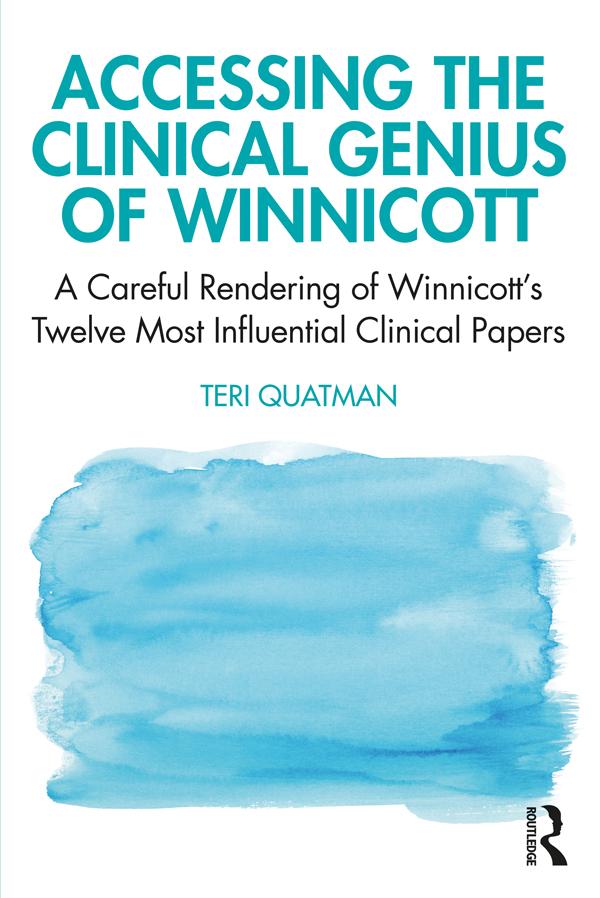
Donald Winnicott, psychoanalyst and pediatrician, is viewed by many in the psychodynamic field as the “other genius” in the history of psychodynamic theory and practice, along with Freud. This book selects and explores twelve of his most infl uential clinical papers.
Winnicott’s works have been highly valued in the decades since they were first published, and are still relevant today. Winnicott’s writings on the goals and techniques of psychodynamic psychotherapy have been foundational, in that he recast Freudian- and Kleinian-infl uenced thinking in the direction of the more relational schools of psychotherapy that define current 21st-century psychodynamic practice. Winnicott’s writings help us to understand the maturational processes of children, certainly. But more than that, they help us to understand how best to intervene when the enterprise of childhood leads to compromises of psychological health in later years. Yet, despite Winnicott’s influence and continuing relevance, his writings, while at some level simple, are elusive to modern readers. For one thing, he writes in the psychoanalytic genre of the 1930s-1960s, whose underlying theoretical assumptions and vocabulary are obscure in the present day and, for another, his writing often reflects primary process thinking, which is suggestive, but not declarative. In this work, Teri Quatman provides explanations and insight, in an interlocution with Winnicott’s most significant papers, exploring both his language and concepts, and enabling the clinician to emerge with a deep and reflective understanding of his thoughts, perspectives, and techniques.
Engaging and accessible, Accessing the Clinical Genius of Winnicott will be of great use to anyone encountering Winnicott for the first time, particularly in psychodynamic psychotherapeutic training, and in the teaching of relational psychotherapies.
Pay easily by card, Klarna, Apple Pay or Google Pay. Not happy? You always have a 14-day money-back guarantee. Read more in our terms. If you have any questions, email us at hello@memmo.org.
Memmo makes studying easier – wherever you are in the world. We bring your course books and smart study tools together in one place: summaries, quizzes, podcasts and flashcards. Plus Ted, your study buddy who answers anything you wonder. Over 50,000 students already study here – built to help you learn faster and stress less.