
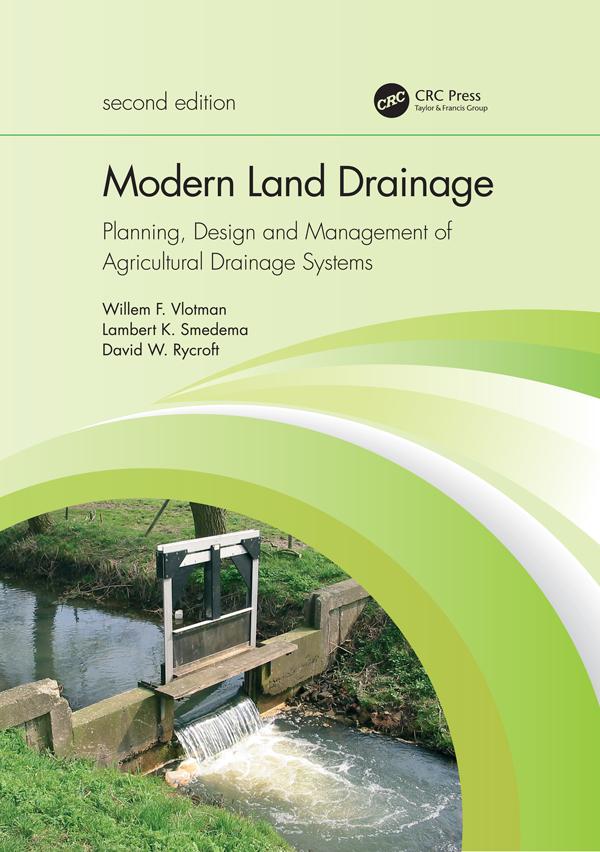
Modern Land Drainage 2nd edition is a fully revised and updated edition of the 2004 edition. Modern Land Drainage describes traditional drainage formulas (Hooghoudt, Kirkham, Donnan, Ernst, Glover-Dumm) for rainfed agriculture in the humid temperature zone. Significant parts are devoted to drainage for salinity control of irrigated land in (semi-) arid zones, and to drainage of rice land in the humid tropics. Institutional, management and maintenance aspects are extensively covered, as well as the mitigation of adverse impacts of drainage interventions on the environment. The latest computer applications for drainage design in the context of integrated water management are described (DRAINMOD, HEC, SWAP, etc.).
Field surveys are executed by governments, with the aid of consultants, but rarely are the end stakeholders (i.e., farmers and general public) involved from inception to planning to execution of a drainage system. Yet, during the Operation, Management and Maintenance (OMM) phase of a water management system, they are expected to takeover, run, bear and be responsible for the costs of OMM. The book describes successful methodologies and processes to be followed for engagement of stakeholders at all levels, from government to farm, from minister to farmer, and, from beginning to end.
The book covers all aspects needed for sustainable drainage. The latest survey methodologies with satellites and drones are suggested to assess cause and effect. Waterlogging and salinity are the effect of something caused most likely upstream of the drainage problem location. Hence treating the cause may be more cost-effective. Triple Bottom Line (social, environmental and financial considerations) and the water-food-energy nexus are an integral part of the drainage design process. Controlled drainage, i.e. the balance of removal and conservation of drainage water and minimising solute transport as low as reasonably achievable (ALARA principle) is extensively described.
This work is intended for use both as a university level textbook and as a professional handbook; it is of particular value to professionals engaged in drainage development in the context of integrated water resources and river basin management, civil and agricultural engineers, government officials, university students and libraries.
Pay easily by card, Klarna, Apple Pay or Google Pay. Not happy? You always have a 14-day money-back guarantee. Read more in our terms. If you have any questions, email us at hello@memmo.org.
Memmo makes studying easier – wherever you are in the world. We bring your course books and smart study tools together in one place: summaries, quizzes, podcasts and flashcards. Plus Ted, your study buddy who answers anything you wonder. Over 50,000 students already study here – built to help you learn faster and stress less.