
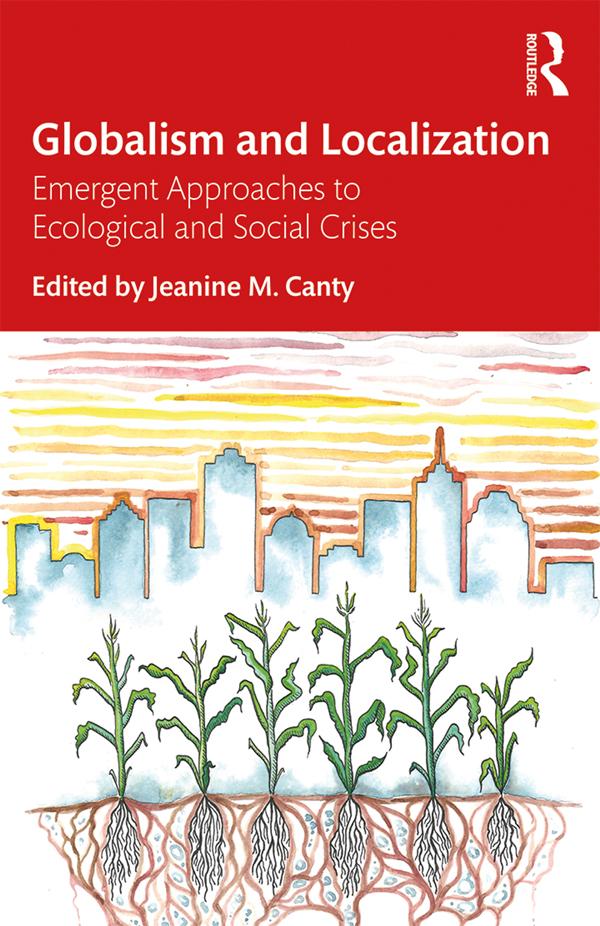
Considering the context of the present ecological and social crisis, this book takes an interdisciplinary approach to explore the relationship between globalism and localization. Globalism may be viewed as a positive emergent property of globalization. The latter depicts a worldwide economic and political system, and arguably a worldview, that has directly increased planetary levels of injustice, poverty, militarism, violence, and ecological destruction. In contrast, globalism represents interconnected systems of exchange and resourcefulness through increased communications across innumerable global diversities. In an economic, cultural, and political framework, localization centers on small-scale communities placed within the immediate bioregion, providing intimacy between the means of production and consumption, as well as long-term security and resilience. There is an increasing movement towards localization in order to counteract the destruction wreaked by globalization, yet our world is deeply and integrally immersed within a globalized reality.
Within this collection, contributors expound upon the connection between local and global phenomenon within their respective fields including social ecology, climate justice, ecopsychology, big history, peace ecology, social justice, community resilience, indigenous rights, permaculture, food justice, liberatory politics, and both transformative and transpersonal studies.
Pay easily by card, Klarna, Apple Pay or Google Pay. Not happy? You always have a 14-day money-back guarantee. Read more in our terms. If you have any questions, email us at hello@memmo.org.
Memmo makes studying easier – wherever you are in the world. We bring your course books and smart study tools together in one place: summaries, quizzes, podcasts and flashcards. Plus Ted, your study buddy who answers anything you wonder. Over 50,000 students already study here – built to help you learn faster and stress less.