
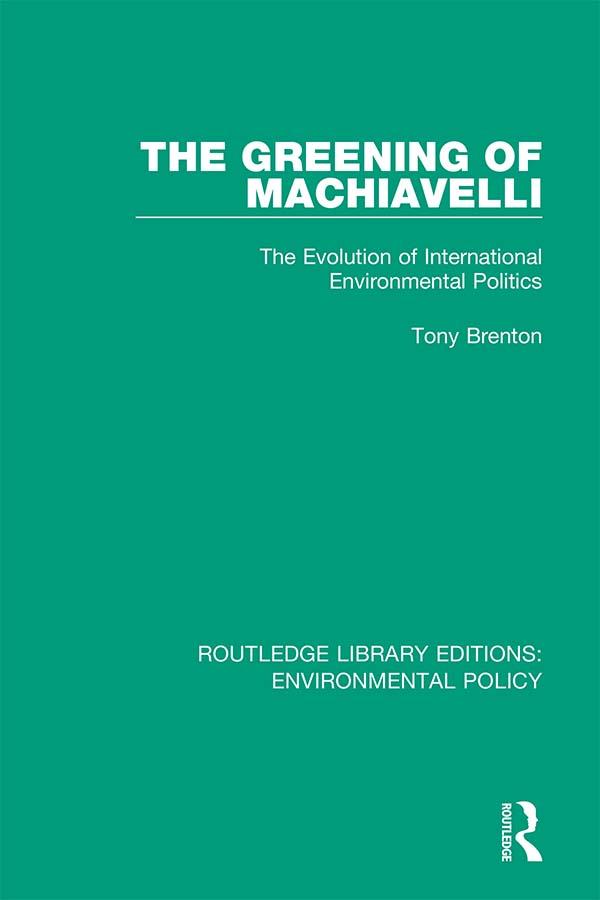
First published in 1994. Environmental issues present a daunting challenge to the international system. The destruction of the tropical rainforest, the Chernobyl explosion and the ozone layer ‘hole’ all underline the transnational nature of environmental threats and the need for states to act together in order to tackle them. How have such environmental issues entered political agendas in different parts of the world and how has that affected national positions? Can governments ever reconcile their own national interests with the international cooperation needed to deal with transboundary issues such as climate change?
This book traces the history of international environmental negotiations and regulations and looks at the domestic policies upon which cooperation in the international community depends. It covers some major milestones in recent history, from the Torrey Canyon accident through to the Rio ‘Earth Summit’ and the emergence of the European Community as a major international environmental actor. It also looks at cross-cutting issues such as the role of non-governmental organizations, the environmental impacts of world agriculture and trading arrangements, industry’s attitudes, and the relationship between democracy and environmental protection. It concludes by examining how the international system has adapted, and may adapt further, to deal effectively with environmental problems, and reflects on the implications of this for the future.
Pay easily by card, Klarna, Apple Pay or Google Pay. Not happy? You always have a 14-day money-back guarantee. Read more in our terms. If you have any questions, email us at hello@memmo.org.
Memmo makes studying easier – wherever you are in the world. We bring your course books and smart study tools together in one place: summaries, quizzes, podcasts and flashcards. Plus Ted, your study buddy who answers anything you wonder. Over 50,000 students already study here – built to help you learn faster and stress less.