
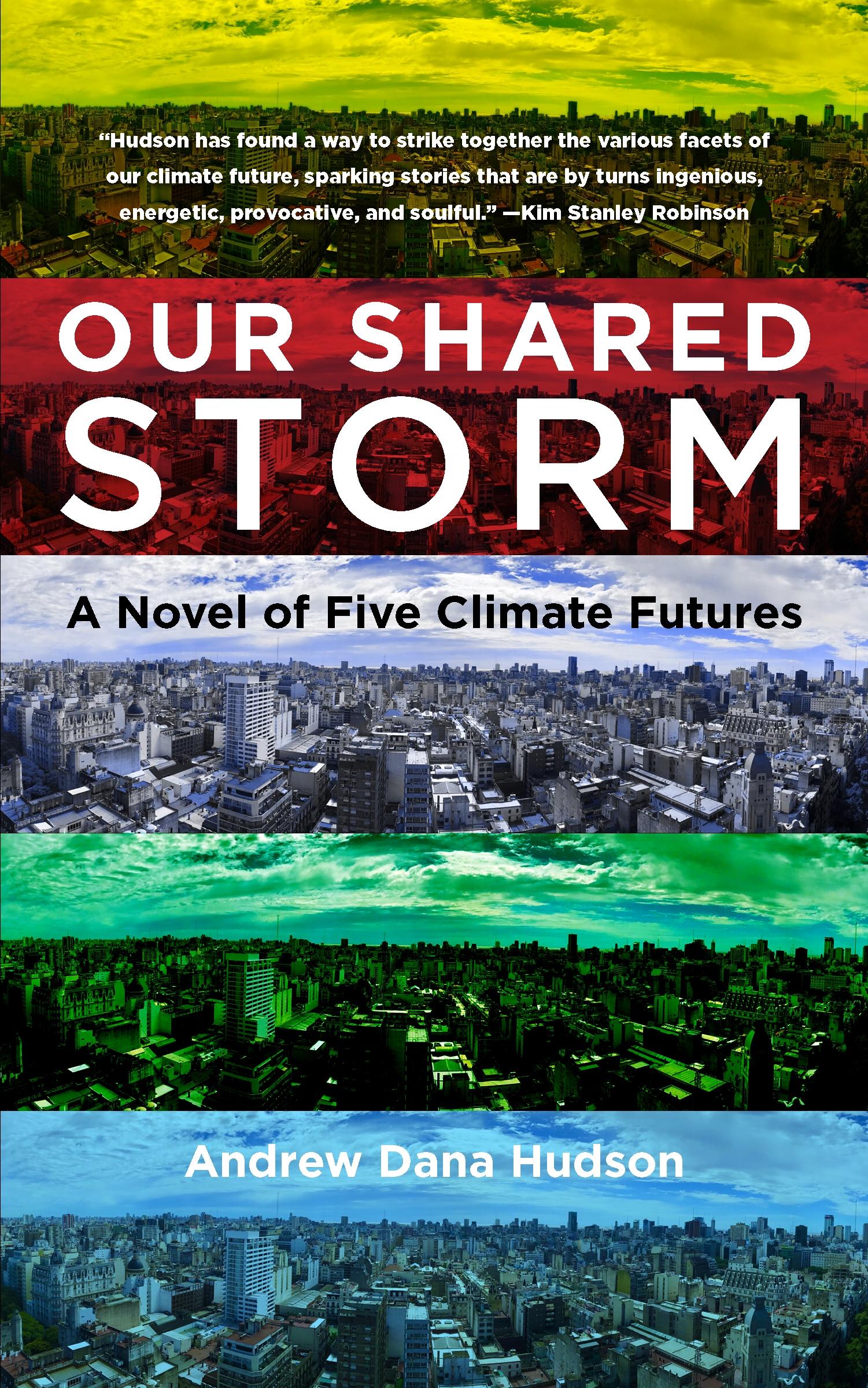
Through speculative fiction, five interlocking novelettes explore the possible realities of our climate future.
What is the future of our climate? Given that our summers now regularly feature Arctic heat waves and wildfire blood skies, polar vortex winters that reach all the way down to Texas, and “100-year” storms that hit every few months, it may seem that catastrophe is a done deal. As grim as things are, however, we still have options. Combining fiction and nonfiction and employing speculative tools for scholarly purposes, Our Shared Storm explores not just one potential climate future but five possible outcomes dependent upon our actions today.
Written by speculative-fiction writer and sustainability researcher Andrew Dana Hudson, Our Shared Storm features five overlapping fictions to employ a futurist technique called “scenarios thinking.” Rather than try to predict how history will unfold—picking one out of many unpredictable and contingent branching paths—it instead creates a set of futures that represent major trends or counterposed possibilities, based on a set of climate-modeling scenarios known as the Shared Socioeconomic Pathways (SSPs).
The setting is the year 2054, during the Conference of the Parties global climate negotiations (a.k.a., The COP) in Buenos Aires, Argentina. Each story features a common cast of characters, but with events unfolding differently for them—and human society—in each alternate universe. These five scenarios highlight the political, economic, and cultural possibilities of futures where investments in climate adaptation and mitigation promised today have been successfully completed, kicked down the road, or abandoned altogether. From harrowing to hopeful, these stories highlight the choices we must make to stabilize the planet.
Our Shared Storm is an experiment in deploying practice-based research methods to explore the opportunities and challenges of using climate fiction to engage scientific and academic frameworks.
Pay easily by card, Klarna, Apple Pay or Google Pay. Not happy? You always have a 14-day money-back guarantee. Read more in our terms. If you have any questions, email us at hello@memmo.org.
Memmo makes studying easier – wherever you are in the world. We bring your course books and smart study tools together in one place: summaries, quizzes, podcasts and flashcards. Plus Ted, your study buddy who answers anything you wonder. Over 50,000 students already study here – built to help you learn faster and stress less.