
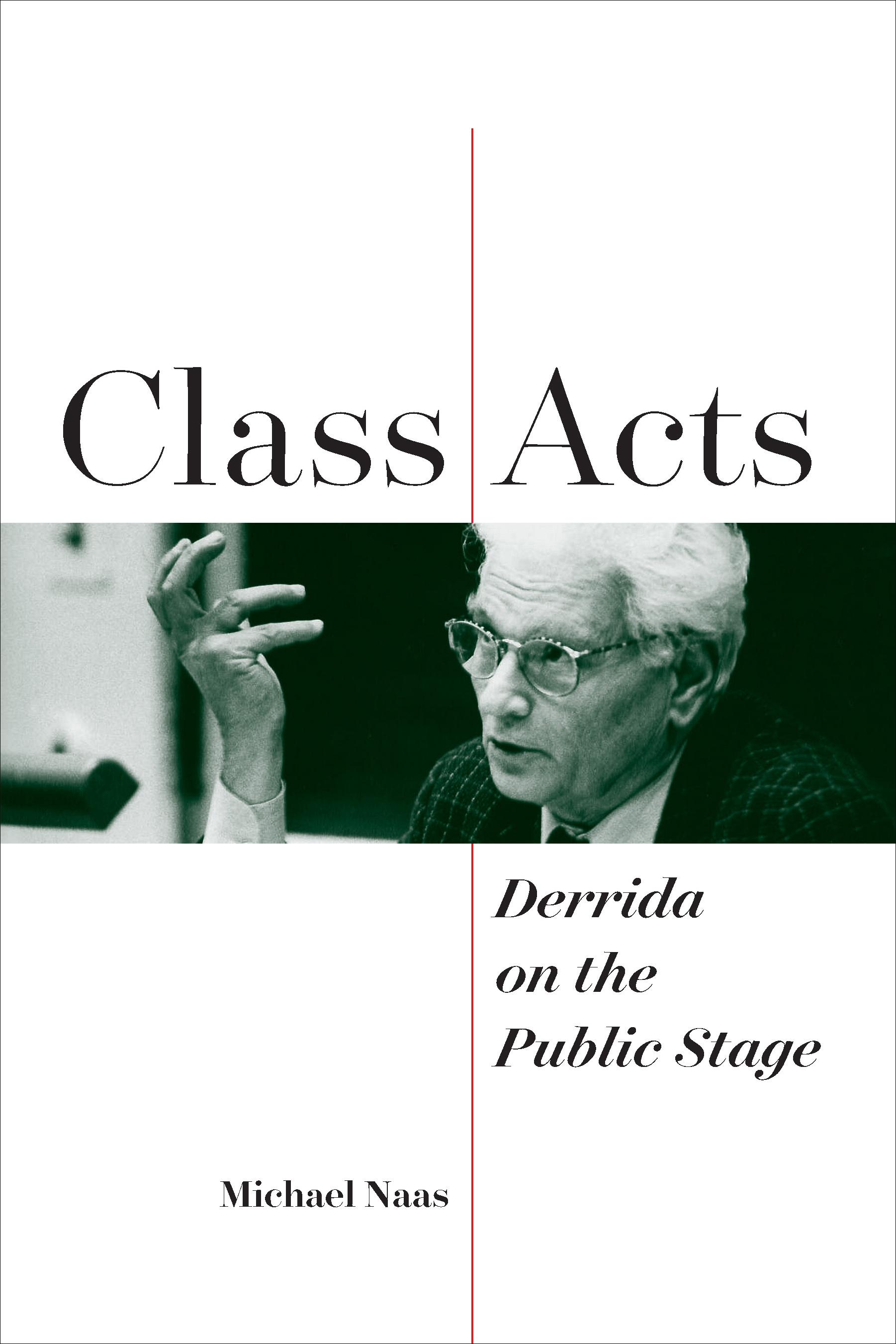
Class Acts examines two often neglected aspects of Jacques Derrida’s work as a philosopher, his public presentations at lectures and conferences and his teaching, along with the question of the “speech act” that links them. What, Michael Naas asks, is one doing when one speaks in public in these ways?
The book follows Derrida’s itinerary with regard to speech act theory across three public lectures, from 1971 to 1997, all given, for reasons the book seeks to explain, in Montreal. In these lectures, Derrida elaborated his critique of J. L. Austin and his own subsequent redefinition of speech act theory. The book then gives an overview of Derrida’s teaching career and his famous “seminar” presentations, along with his own explicit reflections on pedagogy and educational institutions beginning in the mid-1970s. Naas then shows through a reading of three recently published seminars—on life death, theory and practice, and forgiveness—just how Derrida the teacher interrogated and deployed speech act theory in his seminars. Whether in a conference hall or a classroom, Naas demonstrates, Derrida was always interested in the way spoken or written words might do more than simply communicate some meaning or intent but might give rise to something like an event. Class Acts bears witness to the possibility of such events in Derrida’s work as a pedagogue and a public intellectual.
Pay easily by card, Klarna, Apple Pay or Google Pay. Not happy? You always have a 14-day money-back guarantee. Read more in our terms. If you have any questions, email us at hello@memmo.org.
Memmo makes studying easier – wherever you are in the world. We bring your course books and smart study tools together in one place: summaries, quizzes, podcasts and flashcards. Plus Ted, your study buddy who answers anything you wonder. Over 50,000 students already study here – built to help you learn faster and stress less.